Answer Engine Optimization: How to Get Your Brand Cited by AI Search in 2026
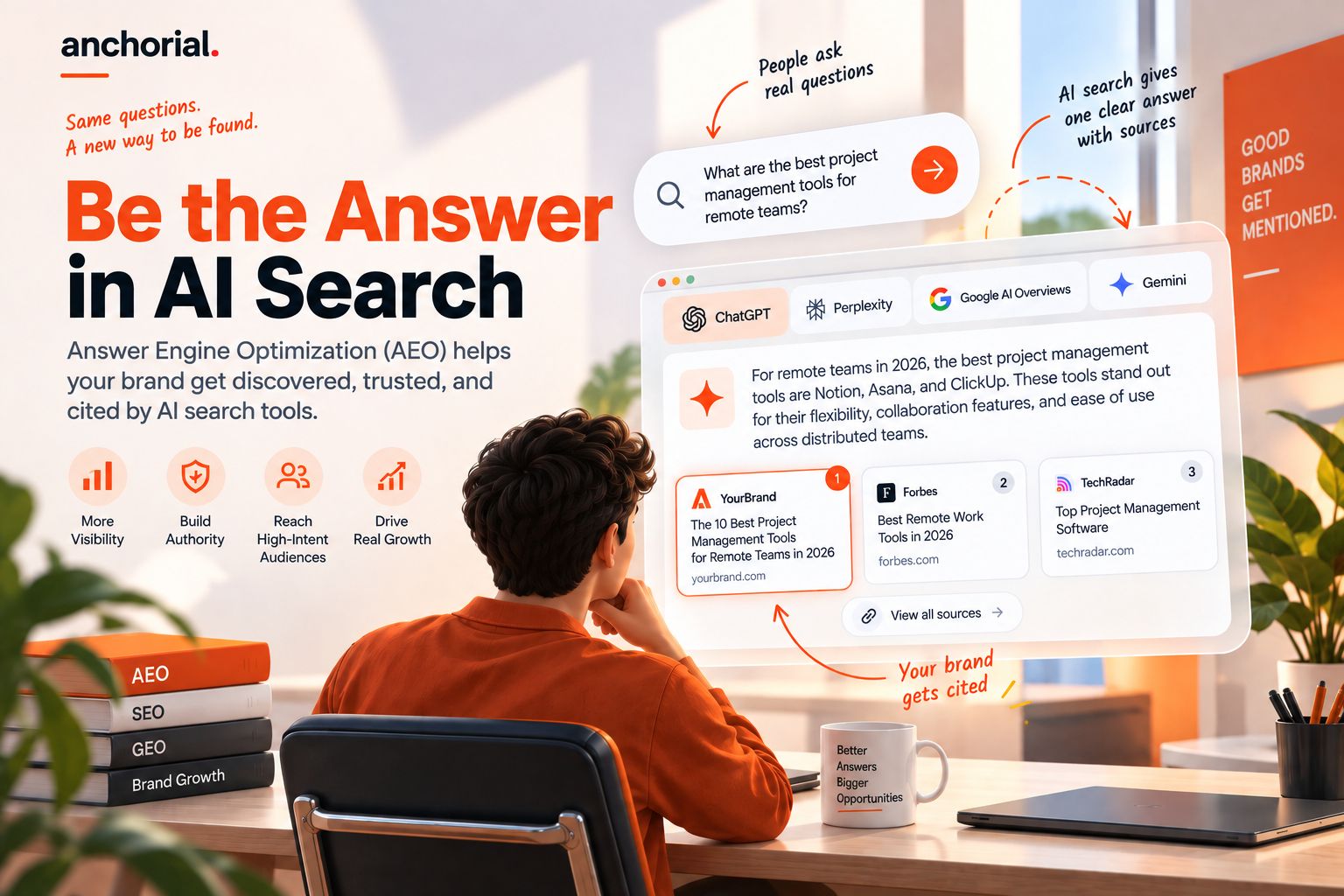
Search changed while you were busy ranking for it. People used to type a few words, scan a page of blue links, and click. Now they ask a full question and get one answer back. No list. No scrolling. Just the answer.
Roughly 6 in 10 searches in the United States now end without a single click to another website. Your content can rank on page one and still be invisible, because the answer already appeared above the links.
Answer engine optimization is how you fix that. It is the practice of structuring your content so AI search tools like ChatGPT, Perplexity, and Google AI Overviews pick it, trust it, and cite it as the answer. This guide covers what AEO is, how it differs from SEO and GEO, how answer engines choose sources, and the exact steps to get cited. Every claim is backed by current data.
AEO by the numbers
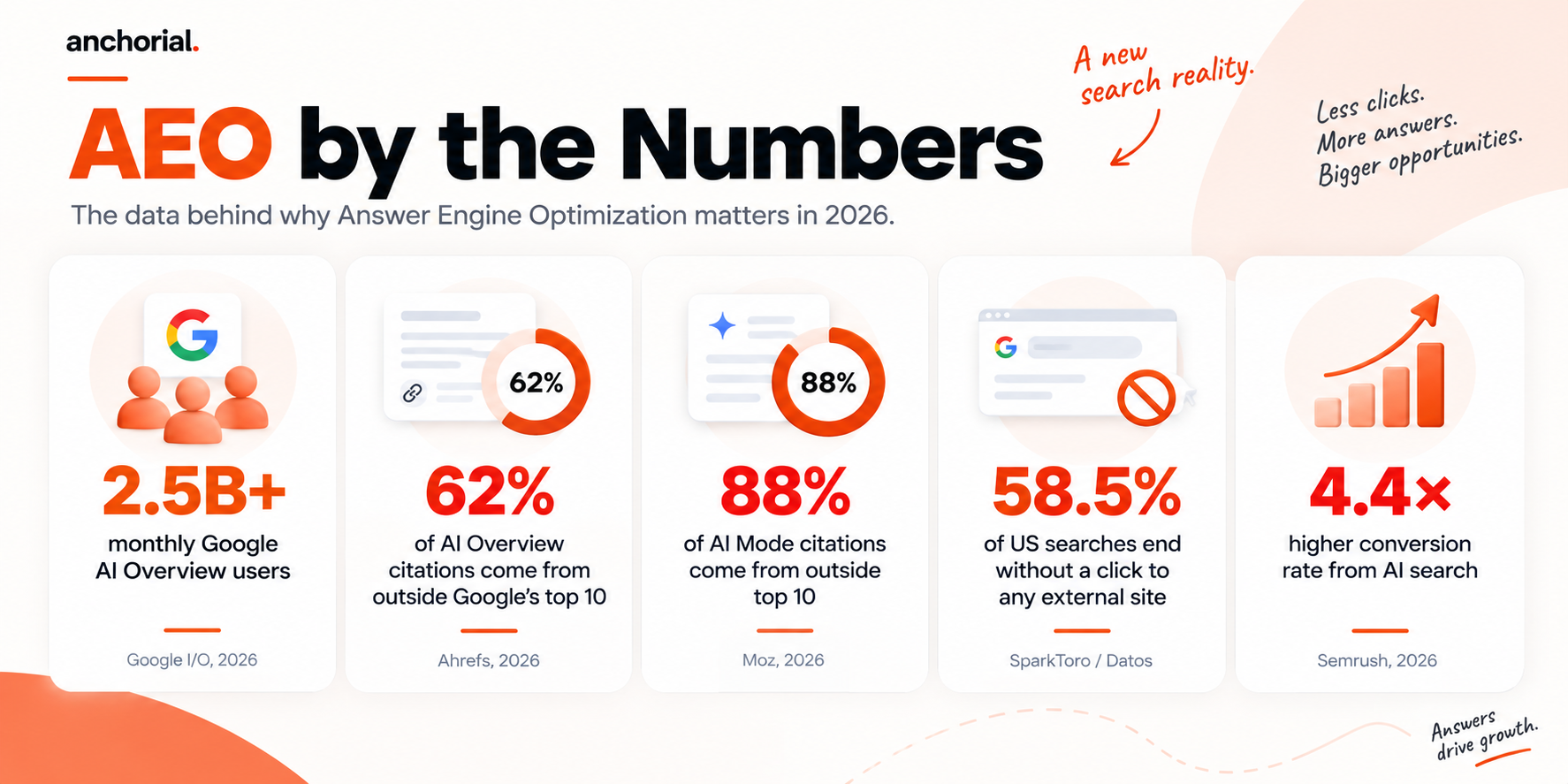
- Google AI Overviews reached more than 2.5 billion monthly users (Google I/O, 2026).
- Across both of Google's AI surfaces, most citations come from outside the top 10. In AI Overviews, it's about 62% (Ahrefs, 2026). In AI Mode, it's 88% (Moz, 2026).
- About 58.5% of US Google searches end without a click to any external site (SparkToro/Datos).
- When an AI Overview appears, people click a result 8% of the time, versus 15% without one (Pew Research).
- Visitors from AI search convert at 4.4 times the rate of traditional organic traffic (Semrush).
What Is Answer Engine Optimization?
Answer engine optimization is the practice of optimizing content so AI-powered engines select it as the cited answer to a user's question. It targets ChatGPT, Perplexity, Google AI Overviews, Gemini, and voice assistants. The goal is not ranking. The goal is to be the answer.
Traditional SEO wants a click. AEO wants a citation. An engine reads your page, lifts a clean answer, and credits you as the source. Sometimes the user never visits your site at all. Your brand still wins, because it showed up in the answer that shaped the decision.
AEO is one part of a bigger practice called generative engine optimization, or GEO. Think of GEO as the whole field of getting seen inside AI-generated results. AEO is the slice focused on becoming the direct answer. More on that difference below.
AEO vs SEO: What Actually Changed
AEO and SEO share the same foundation, but they optimize for different finish lines. SEO earns rankings and clicks. AEO earns citations inside answers. You need both, because a strong SEO base still helps engines find and trust you.
Here is the proof that they are separate games. Only about 38% of URLs cited by AI engines also rank in Google's top 10 for that query. A page sitting at position 14 can still get cited if it answers the question best. Ranking well helps. It does not guarantee a citation.
AEO vs GEO: Clearing Up the Confusion
People use AEO and GEO as if they mean the same thing. They do not. Generative engine optimization is the broad practice of earning visibility across AI-generated results. Answer engine optimization is the narrower job of becoming the direct answer to a specific question.
Put simply, AEO lives inside GEO. GEO covers your whole presence in AI answers, including mentions, brand framing, and how models describe you. AEO zeroes in on the extractable answer itself, the definition, comparison, or stat an engine can lift and cite.
You do not have to choose. Strong AEO feeds your GEO. Every answer you get cited for builds the broader visibility GEO is after.
Why AEO Matters Right Now
AEO matters now because AI answers have gone mainstream, fast. Google AI Overviews reached more than 2.5 billion monthly users in 2026. Gartner expects traditional search volume to fall 25% by 2026. The audience is moving to answers, not links.
Zero-click search is the new normal. When an AI Overview shows up, only 8% of people click a result, down from 15% without one. Your traffic can drop even when your rankings hold. The click went to the answer box, not to you.
Now for the part that is easy to miss. This shift is not a death sentence. It is a channel change. Visitors who do arrive from AI search convert at 4.4 times the rate of traditional organic visitors. Fewer clicks, warmer clicks. Being cited builds trust before the visit even happens.
How Answer Engines Actually Work
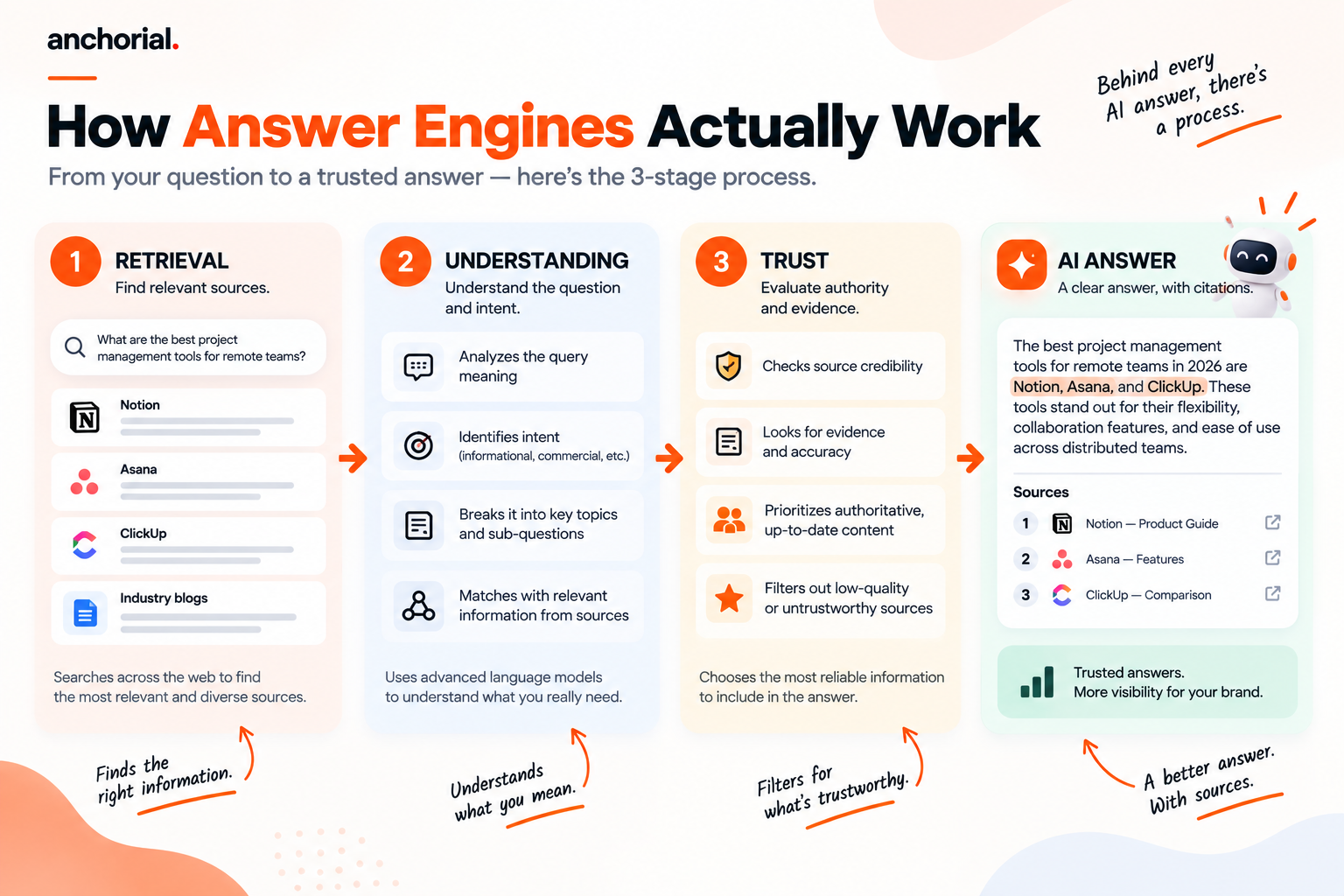
Answer engines do not rank pages. They build answers. An engine reads a question, pulls a handful of sources, scores them, and stitches together a response. On average, it cites only about 3.6 sources per answer. That is a short list to make.
Three things decide whether you make that list.
- Retrieval. The engine has to find your content. If it cannot crawl or parse your page, you are out before scoring begins.
- Understanding. The engine reads intent, not just keywords. It needs to see a clear answer to the actual question, in plain language.
- Trust. The engine weighs authority and evidence. It favors sources that are specific, current, and backed by other mentions across the web.
One pattern shows up again and again. Engines lean on third-party sources, not just your own site. Your homepage rarely wins the answer on its own. The pages that cite you often do.
How to Optimize for Answer Engines
You optimize for answer engines by making your answer the easiest one to find, verify, and reuse. Start with the question. End with a clean, quotable answer. Here is how, step by step.
Think in Questions
Answer engines run on questions. So map the real questions your buyers ask. Use People Also Ask, Reddit threads, and your own support tickets. Group them by intent, then write a section for each one.
Say you sell project management software. A buyer asks, "What is the best project tool for remote teams?" That single question can anchor a whole section, a heading, and a direct answer.
Put the Answer Upfront (BLUF)
Lead with the answer. State it in the first line, then add context below. This is the bottom-line-upfront approach, and the data backs it hard. About 55% of AI Overview citations come from the first 30% of the page.
Keep the lead answer to 40 to 60 words. Make it a complete thought. An engine should be able to lift it and use it without reading the rest of the section.
Structure and Format for Extraction
Format decides whether a machine can parse you. Semrush found that clarity and summarization were the strongest positive signals for getting cited. So write to be skimmed and lifted.
- Use question-style headings, then answer them directly underneath.
- Break ideas into short paragraphs. One idea per sentence, where you can.
- Add bullet points, tables, and steps. Listicles are among the most cited formats in AI answers.
- Keep a clear subject, verb, object structure. Simple sentences parse better.
Handle Schema Honestly
Schema helps machines understand your content. FAQ, HowTo, and Article markup all make your structure clearer. Use them. Just do not treat schema as a magic switch.
Google has said plainly that no special schema is required for its AI search features. Schema is an aid, not a cheat code. The answer still has to be good.
Build Authority and Entities
Engines trust entities they recognize. So be specific and consistent. Name your product, your category, and your people clearly across the web. Vague brands get skipped.
Back your claims with evidence. Cite data. Add current dates. A page updated in 2026 with real numbers beats a stale page every time. Authority is what turns a candidate source into a cited one.
How Each AI Engine Cites Differently
Every engine picks sources its own way. Optimizing for one does not cover the rest. In fact, ChatGPT and Perplexity share only about 11% of their citation sources. Each engine needs its own footprint.
- ChatGPT. Cites fewer sources, but uses them deeply. It leans on reference sites, documentation, and strong third-party pages.
- Perplexity. Cites broadly and shows its sources openly. Fresh, well-structured pages do well here.
- Google AI Overviews. Pulls from related sub-queries, not just the top result. A page that answers an adjacent question can still get cited.
- Gemini. Ties into Google's ecosystem and favors clear, structured, authoritative content.
The takeaway is simple. Track your visibility across all of them. A win on ChatGPT is not a win on Gemini.
Off-Site Authority and Earned Media
Here is the truth most on-page guides skip. AI engines lean heavily on earned media, not your own pages. In some categories, ChatGPT and Claude pull 93% or more of their citations from third-party sources. Your site alone will not carry you.
So where do citations actually come from? A short list of source types does most of the work.
- Listicles and roundups. The "best tools for X" pages engines love to quote. These are the single most cited content type in AI answers.
- Community sites. Reddit and similar forums show up constantly in AI citations.
- Reference sites. Wikipedia and category wikis carry heavy trust.
- Review and comparison platforms. Third-party sites that rate products in your category.
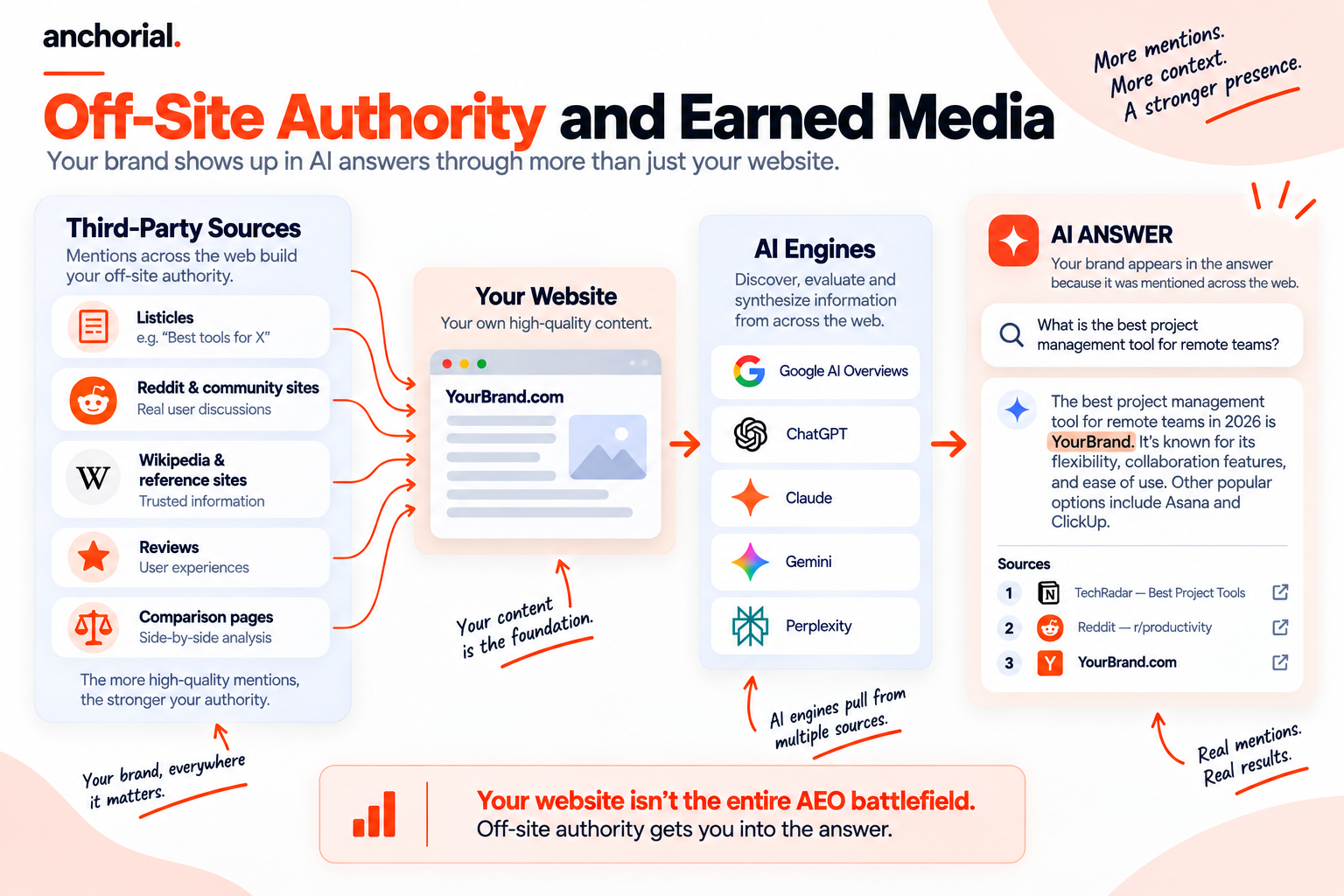
The pattern is clear. If a buyer asks an engine for the best tool in your category, the answer comes from a few roundups and comparison pages. If your brand sits on those pages, you get recommended. If it does not, the engine recommends whoever is there instead.
How to Measure Your AEO
You cannot improve what you do not track. AEO needs its own metrics, because rankings alone will not show whether you are being cited. Watch these four.
- Citation frequency. How often engines cite you for your key questions.
- Share of voice. How your citations compare to competitors on the same queries.
- Brand mentions. How often engines name you, even without a link.
- AI referral traffic. The visits and conversions that trace back to AI search.
Pick a fixed set of buyer questions. Check them across engines on a schedule. Record who gets cited, and who keeps replacing you. That gap is your roadmap.
Answer Engine Optimization Tools Worth Knowing
Answer engine optimization tools fall into three buckets. You need something from each to run a real program. Here is how they break down.
- Tracking and monitoring. Tools that watch which pages engines cite for your queries, and whether your brand appears. This is where most programs start.
- Content optimization. Tools that grade your pages for clarity, structure, and answer-readiness, then suggest fixes.
- Schema and technical. Tools that generate and validate structured data so engines parse your content cleanly.
Start with tracking. You cannot close a citation gap you cannot see. Once you know where you are missing, the optimization and technical tools help you fix it.
AEO Services: Do It Yourself or Hire Out
You can run AEO in-house or bring in help. The right call depends on your time, your team, and how competitive your category is. Here is the honest split.
- Do it yourself when you have the bandwidth to research questions, rewrite pages, add schema, and track results month after month. The on-page work is very doable alone.
- Hire out when you need placements on third-party pages, or you are moving too slowly against competitors who started early.
Now, the catch most AEO advice skips. Restructuring your own pages only takes you so far, because engines build answers from third-party sources. Getting added to the pages they already cite is a different job. Most services stop at diagnosis. They audit your prompts, chart your citation gaps, and send a report. Useful, but a report is not a placement.
That is the gap Anchorial closes. They find the exact pages AI engines cite for your buyer queries, reach the editors who own them, and earn your brand a spot on them. You approve every domain. Placements are priced per placement, not buried in a retainer, and they come with a lifetime guarantee. It is the difference between watching the answer and being in it.
Common AEO myths, cleared up
- Schema is a magic citation switch. It is not. Google says no special schema is required for AI search. Good answers still do the heavy lifting.
- More FAQs always help. Bolting generic FAQs onto every page is formatting, not strategy. Add them only where real follow-up questions exist.
- Ranking equals citation. It does not. Most AI citations sit outside the organic top 10. Being citable is a separate job from ranking.
Key takeaways
- AEO gets your brand cited as the answer in AI search, not just ranked.
- Citation and ranking are separate. Most cited pages do not sit in the top 10.
- Lead with the answer. Most AI citations come from the first third of the page.
- Each engine cites differently. Track all of them.
- Earned, third-party pages win most citations. Placements matter as much as on-page work.
Frequently Asked Questions
What is answer engine optimization in simple terms?
Answer engine optimization is making your content the answer AI search gives. Instead of chasing a ranking, you structure your page so tools like ChatGPT and Google AI Overviews cite it directly when someone asks a question.
What is the difference between AEO and GEO?
AEO is a part of GEO. Generative engine optimization covers your whole presence in AI results, including mentions and brand framing. Answer engine optimization focuses on one thing, becoming the direct, cited answer to a specific question.
Does AEO replace SEO?
No. AEO builds on SEO. A strong SEO base helps engines find and trust you. AEO adds a new goal on top, getting cited in answers. You run them together, not one instead of the other.
How do I know if my content is getting cited?
Track a fixed set of buyer questions across ChatGPT, Perplexity, Gemini, and Google AI Overviews. Note when your brand appears, when it is cited, and which competitors show up instead. Answer engine optimization tools can automate this tracking.
Which content formats get cited most by AI?
Listicles, comparison tables, FAQs, and short direct answers get cited more often than long blocks of prose. Clear structure helps engines lift your answer without dragging in the rest of the page.
Do I need schema markup for AEO?
Schema helps, but it is not required. Google has stated that no special schema is needed for its AI search features. Use FAQ, HowTo, and Article markup to clarify your content, then focus on the quality of the answer itself.
How long does AEO take to show results?
It varies by engine and category. On-page changes can influence citations within weeks. Earning placements on third-party pages, then seeing citations follow, often takes closer to 90 to 120 days.
Can I do AEO myself or should I hire AEO services?
You can do the on-page work yourself with time and consistency. Many brands hire AEO services when they need placements on third-party pages the engines cite, or when they are falling behind faster-moving competitors.
Why am I ranking on Google but not getting cited by AI?
Because ranking and citation are separate systems. About 88% of AI Mode citations sit outside the organic top 10. Engines often build answers from third-party pages, so your own ranking page may never enter the answer.
Where do most AI citations actually come from?
Mostly from earned, third-party sources. Roundups, community sites, reference pages, and review platforms supply a large share of citations. In some categories, over 93% of citations come from third-party pages, not brand-owned sites.
Conclusion: Be the Answer, Not Just a Result
Search moved from links to answers, and it is not moving back. Ranking still matters, but it is no longer the whole game. If your content is not being cited, it is not really in the conversation.
Answer engine optimization is how you get back in it. Lead with the answer. Write for clarity. Build authority across the web, not just on your own site. Track your citations across every engine. Do that, and you stop watching the answer and start being it.
Your competitors are already in the answer. The reports have shown you that. If you would rather be in it than read about it, Anchorial gets your brand placed on the exact pages ChatGPT, Perplexity, and AI Overviews cite in your category. Start with a citation audit that maps every page you are missing from.