How to Write SEO Content That Ranks on Google and Gets Cited by AI in 2026
Learn how to write SEO content step by step, from keyword research to publishing, so your pages rank on Google and get cited in AI answers.
Krishna Sureka

Here's the truth about SEO in 2026. Good SEO content answers a real question so well that Google ranks it and AI tools quote it. That is the whole game now.
But the ground has shifted under your feet. In 2026, fewer than one in three Google searches still send a click to a website. Your readers don't just scroll through ten blue links anymore. They ask ChatGPT. They search on Perplexity. They read the AI Overview at the top of Google and never click through. So the old playbook, stuff in a keyword and hope, is dead. If your content isn't built to be found and quoted, it's invisible.
Good news. The fix is a repeatable process, and you can learn it.
This guide shows you how to write SEO content step by step, from keyword research to the final edit. You will learn how to plan a piece around what people actually search for, structure it so it's easy to read, place keywords without sounding like a robot, and format it so ChatGPT, Perplexity, and Google AI Overviews can pull you straight into their answers.
Whether you are writing your first post or your five-hundredth, these are the same moves that earn rankings and citations.
No fluff. No theory you'll never use. Just the process real writers rely on, one step at a time.
What Is SEO Content?
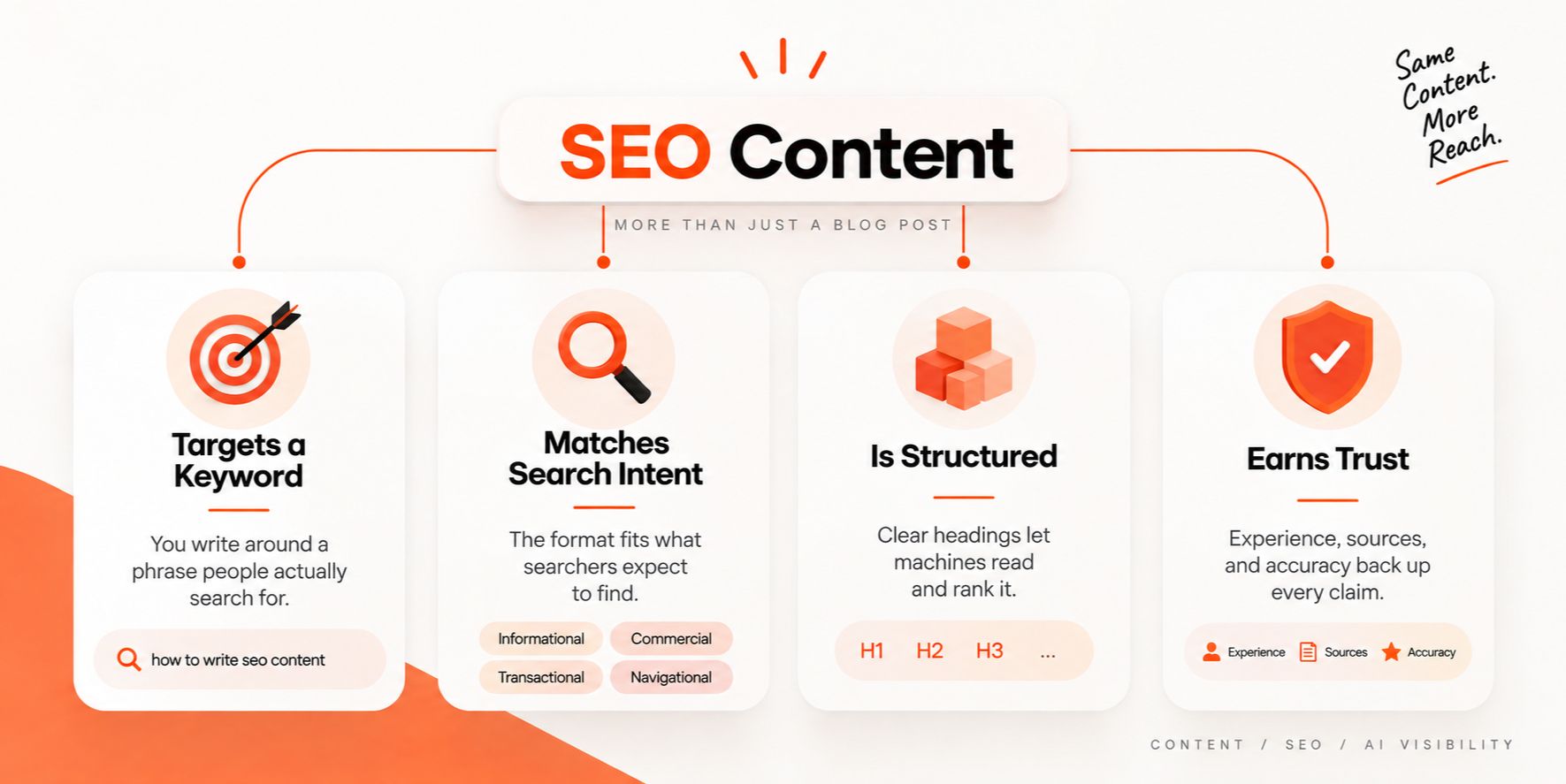
SEO content is content built to rank in search engines and reach the people searching for it. It targets a specific query, answers it clearly, and gives Google and AI models enough signals to trust it.
Regular writing asks one question. Is this good? SEO content asks two. Is this the best answer to a specific search, and is it built so it can be found?
Four things separate SEO content from a normal blog post.
- It targets a keyword. You write around a phrase people actually search for.
- It matches intent. The format fits what searchers expect to find.
- It is structured. Clear headings let machines read and rank it.
- It earns trust. Experience, sources, and accuracy back up every claim.
Get those four right, and you are already ahead of most pages online.
How to Write SEO Content Step by Step
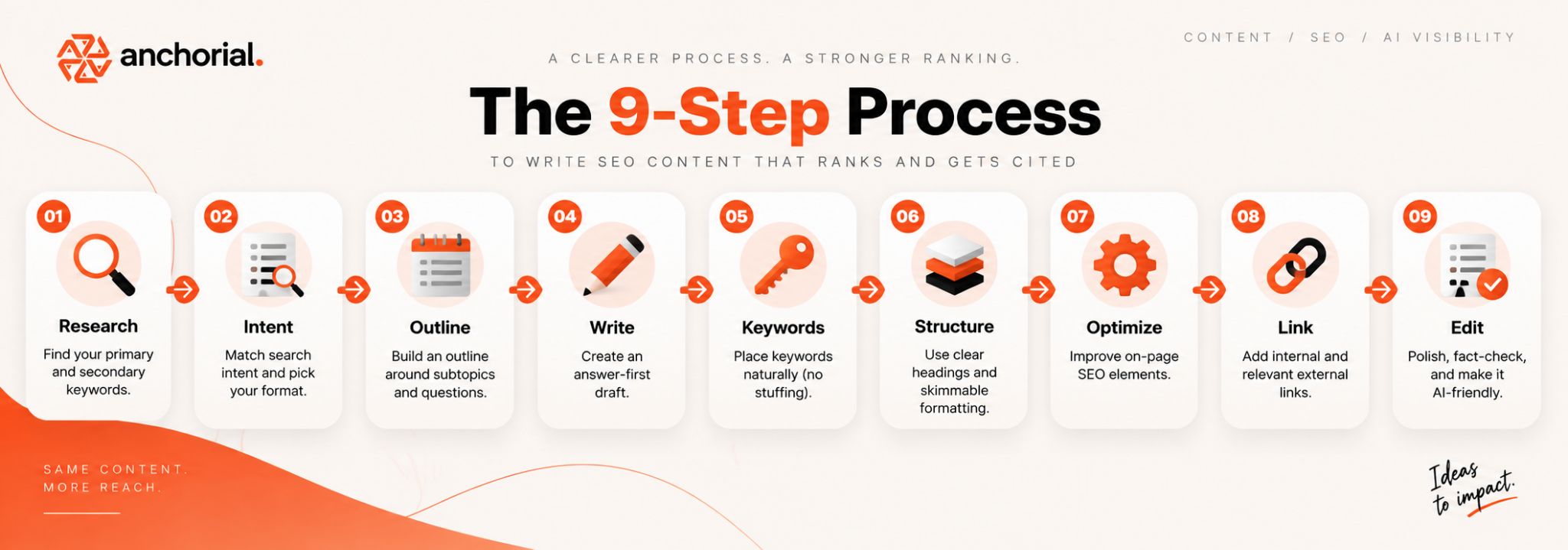
Writing SEO content follows a repeatable process. You research, you plan, you write, then you optimize.
Follow these 9 steps in order, and you will not miss anything that matters.
Step 1. Find Your Primary and Secondary Keywords
Start with one primary keyword. That is the main phrase you want the page to rank for, like how to write SEO content.
Then add secondary keywords. These are close variants, subtopics, and questions that support the main term. For a guide like this, that might include SEO content strategy or SEO content marketing strategy.

Use a tool like Ahrefs or Semrush to check two things before you commit.
Search volume. Enough people should be searching for the term.
Keyword difficulty. It should be realistic for your site to rank.
Pick one primary keyword per page. Trying to rank one post for ten unrelated terms only confuses search engines.
Step 2. Match Search Intent and Pick Your Format
Before you write a word, look at what already ranks. The top results tell you what Google thinks searchers want.
Search intent is the reason behind a query. Someone searching how to write SEO content wants a step-by-step guide, not a product page. Open the top ten results and notice the pattern.
Are they how-to guides, listicles, or comparisons?
How long are the pages that rank?
Which subtopics do they all cover?
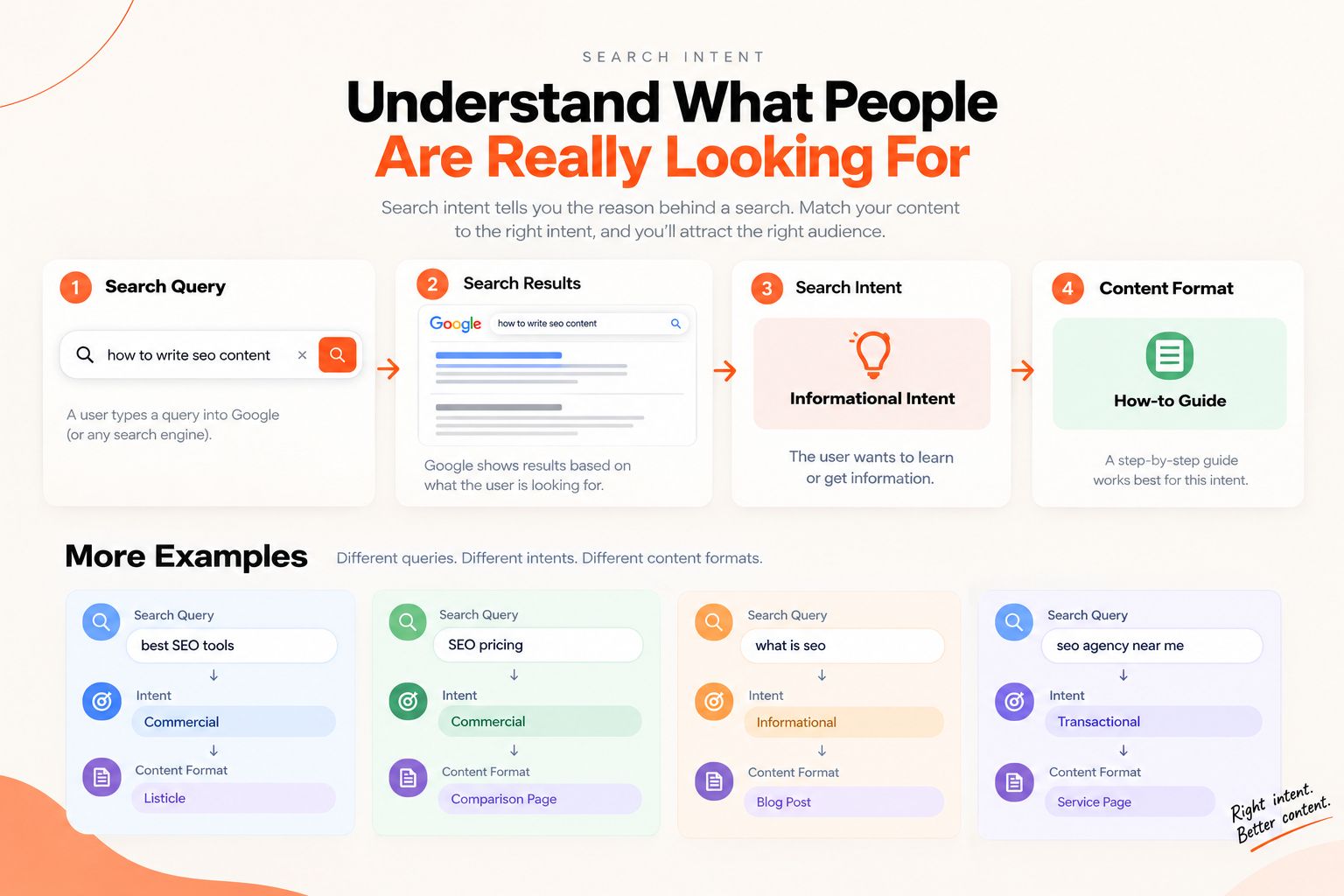
If every top result is a how-to guide, write a how-to guide. Fighting the dominant format is a losing battle.
Step 3. Build an Outline Around Subtopics and Questions
An outline is your article skeleton. It keeps you from rambling and makes sure you cover the full topic. Build it from three sources.
- Competitor headings. See which sections the top pages all include.
- People Also Ask. Pull the questions Google shows for your query.
- Related searches. Check the suggestions at the bottom of the results.
Map these into H2 and H3 headings before you write. A strong outline is half the work.
Step 4. Write an Answer-First Draft
Lead with the answer. Then explain it. This is called BLUF, or bottom line up front.
Readers get what they came for fast, and AI engines can lift your clear answer straight into their responses. Open each section with one or two sentences that answer the heading directly. Support it with detail, examples, and context after.
Keep your first draft loose. You are getting ideas down, not polishing. Write like you are explaining the topic to a smart friend.
Step 5. Place Keywords Naturally
Use your keywords where they fit, not everywhere you can. Search engines reward relevance, not repetition.
Work your primary keyword into the title, the intro, at least one heading, and the conclusion. Sprinkle secondary keywords across headings and body text where they read naturally. Then stop. Keyword stuffing makes your writing worse and can trigger a penalty.
Pro Tip
Aim for a keyword density of 1 to 2 percent. That is one keyword phrase roughly every 150 to 200 words. Count each phrase as a single use, then divide by your total word count. If a keyword feels forced when you read the sentence out loud, cut it.
Step 6. Structure With Headings and Skimmable Formatting
Structure is not decoration. It is how both readers and machines understand your page.
Use one H1 for the title. Break the body into H2 sections, then H3 and H4 subsections under them. Each heading should describe exactly what follows. Then make the page easy to skim.
- Keep paragraphs to two or three lines.
- Use bullet points for lists and steps.
- Add white space so nothing feels like a wall of text.
Scannable content keeps readers on the page longer, and that tells Google your page is worth ranking.
Step 7. Optimize Your Title Tag, Meta Description, and URL Slug
These three elements decide how your page looks in search results and whether people click.
- Title tag. Put your primary keyword near the front and keep it under about 60 characters.
- Meta description. Write one or two sentences that earn the click, and include your keyword.
- URL slug. Keep it short, add your keyword, and separate words with hyphens.
Small details, but they drive real clicks.
Step 8. Add Internal and External Links
Links build context and trust. They show search engines how your content connects to the wider web.
- Internal links. Point to your own related pages to keep readers on your site and spread ranking power.
- External links. Point to credible sources to back up claims and show you did your research.
Use descriptive anchor text so the link tells the reader where it goes. Link only where it genuinely helps.
Step 9. Edit for Readability and E-E-A-T
Great SEO content is edited, not just written. Your first draft is never your best draft.
Read it out loud and cut anything that slows the reader down. Then check it against E-E-A-T, which stands for experience, expertise, authoritativeness, and trust. Strengthen trust in three ways.
- Add first-hand experience and specific examples.
- Cite credible sources for any stat or claim.
- Show a clear author byline and keep information current.
If a claim could be challenged, back it with a source. That is what makes AI engines treat you as a reliable pick.
How to Write SEO Content That AI Engines Cite
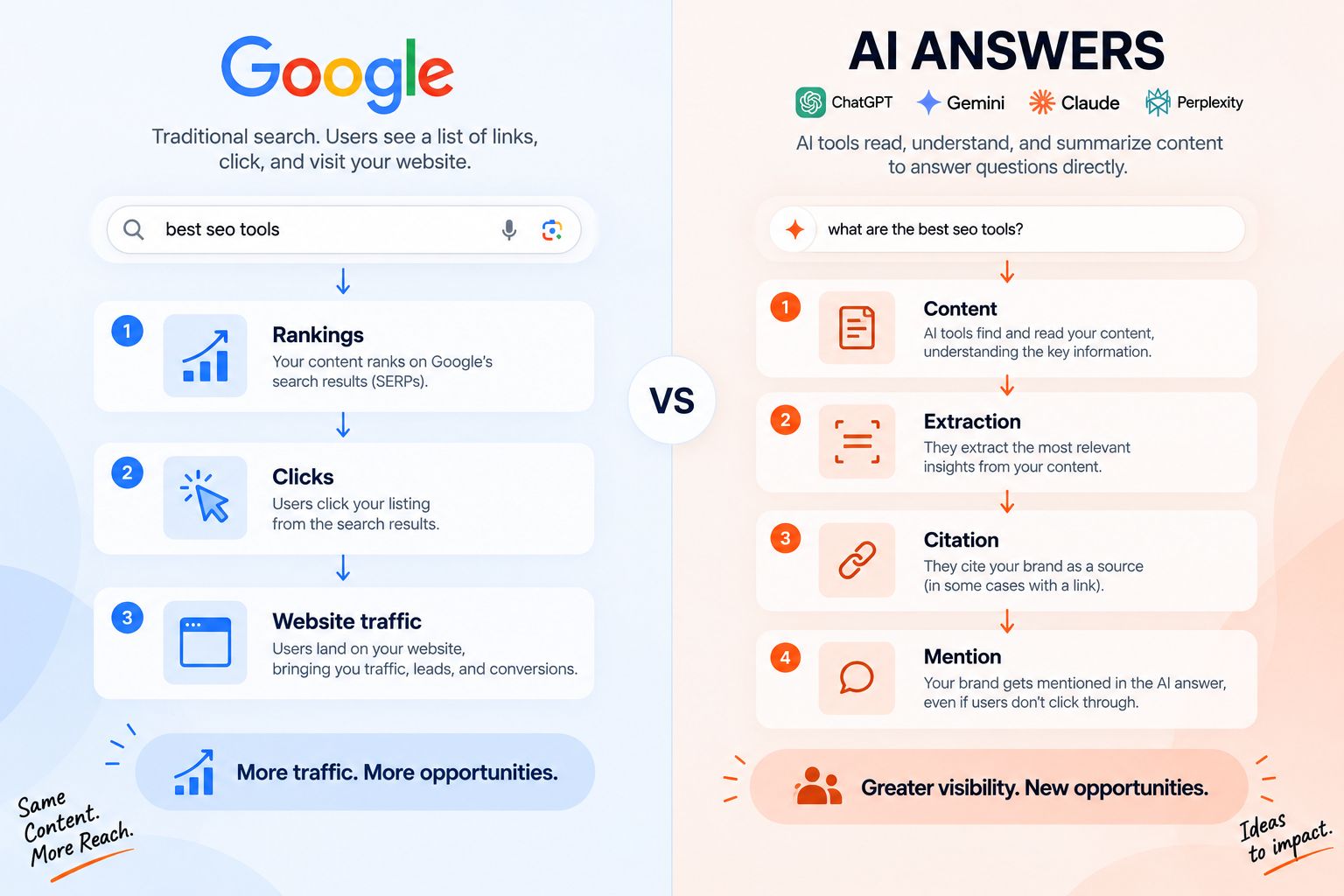
To get cited by AI, make your content easy to quote and easy to extract. Answer engines like ChatGPT, Perplexity, and Google AI Overviews build answers from clear, self-contained facts, not long, winding paragraphs. Here is how to write for that.
- Lead with the answer. Put a direct, 30 to 60 word answer near the top of each section.
- Write quotable definitions. Give one clean sentence an engine can lift word for word.
- Use real numbers. Stats and data get pulled into answers more than opinions do.
- Name entities clearly. Mention specific tools, brands, people, and places so models grasp the context.
- Keep sentences short. One idea per sentence is easier for a machine to parse.
Think of each section as a standalone answer. If someone read only that block, it should still make sense.
Writing for Google vs Writing for AI Answers
Both matter, and they overlap, but they reward slightly different things.
| Factor | Writing for Google | Writing for AI answers |
| Main goal | Rank in the list of links | Get quoted inside the answer |
| Payoff | Earns clicks | Earns mentions and citations |
| Content shape | One comprehensive page | Self-contained, extractable blocks |
| Best format | In-depth guide | Answer-first blocks, stats, tables |
| Key signal | Backlinks and relevance | Clarity, structure, citable sources |
The Honest Limit of On-Page Writing
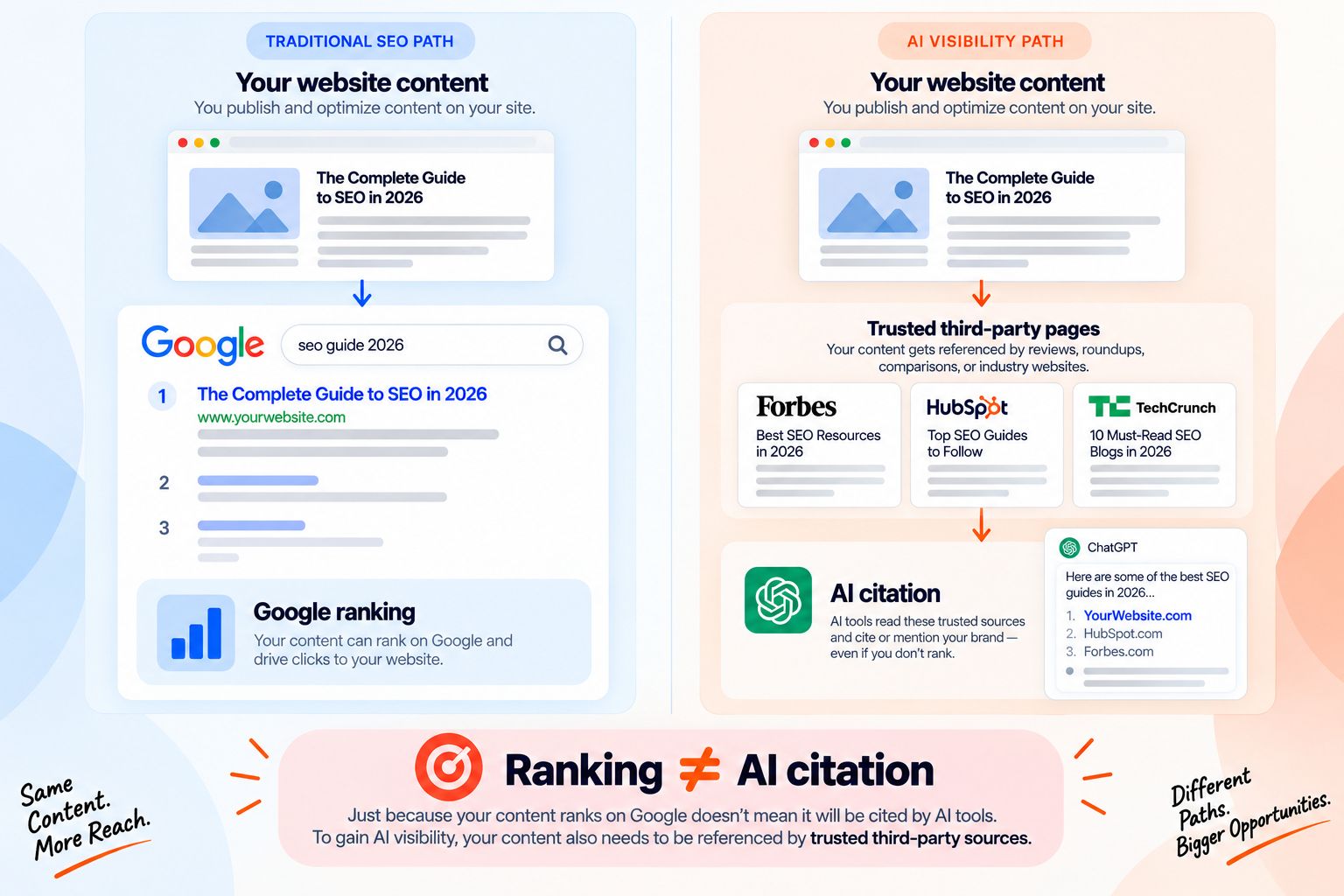
Here is what most SEO guides will not tell you. Perfect on-page writing has a ceiling.
AI engines mostly cite third-party pages, not your own site. When someone asks ChatGPT for the best tool in a category, the answer comes from roundups, comparisons, and listicles that mention the brand. Around 88 percent of pages cited by AI engines do not even rank in Google's top 10.
So your own content gets you ranked. Getting cited in AI answers also depends on being present on the external pages those engines already trust. That is a different job from writing, and it is worth planning for from the start.
A Worked Example. Writing an SEO Article From Scratch
Let us put the process together with a quick example. Say your primary keyword is email marketing tips. Here is how the first few steps play out.
- Intent check. The top results are all listicles, so you write a listicle.
- Outline. You pull subtopics like subject lines, segmentation, and send times from competitor headings and People Also Ask.
- Answer-first intro. The best email marketing tip is simple. Send fewer, more relevant emails to people who want them.
- Title tag. 15 Email Marketing Tips That Actually Boost Opens (2026).
Notice how each move follows the steps above. Research shapes the format, the outline covers the full topic, and the intro answers the query in the very first line.
How Writing Fits Into Your SEO Content Strategy
One great article is a tactic. An SEO content strategy is the system that makes every article work together.
A strong SEO content strategy connects related posts so they build authority as a group, not in isolation. Your SEO content marketing strategy decides which topics to target, in what order, and how they support your business goals. Here is how single pieces fit the bigger plan.
- Topic clusters. Group related posts around one main theme.
- Pillar pages. Link a central page to the supporting posts beneath it.
- Steady cadence. Publish on a regular schedule instead of in random bursts.
- Content refreshes. Update older posts so they keep their rankings over time.
Writing skill gets one page to rank. Strategy gets your whole site to grow.
SEO Content Writing Mistakes to Avoid
Most SEO content fails for the same handful of reasons. Avoid these, and you are ahead of most of the web.
- Writing for keywords, not people. Search engines are not your audience. Readers are.
- Ignoring search intent. A great essay that answers the wrong query will not rank.
- Burying the answer. Long throat-clearing intros lose readers and citations.
- Stuffing keywords. Repetition reads as spam to Google and AI models.
- Skipping structure. No headings means no easy ranking and no citations.
- Forgetting internal links. Orphan pages waste your ranking power.
Before You Hit Publish. Your SEO Content Checklist
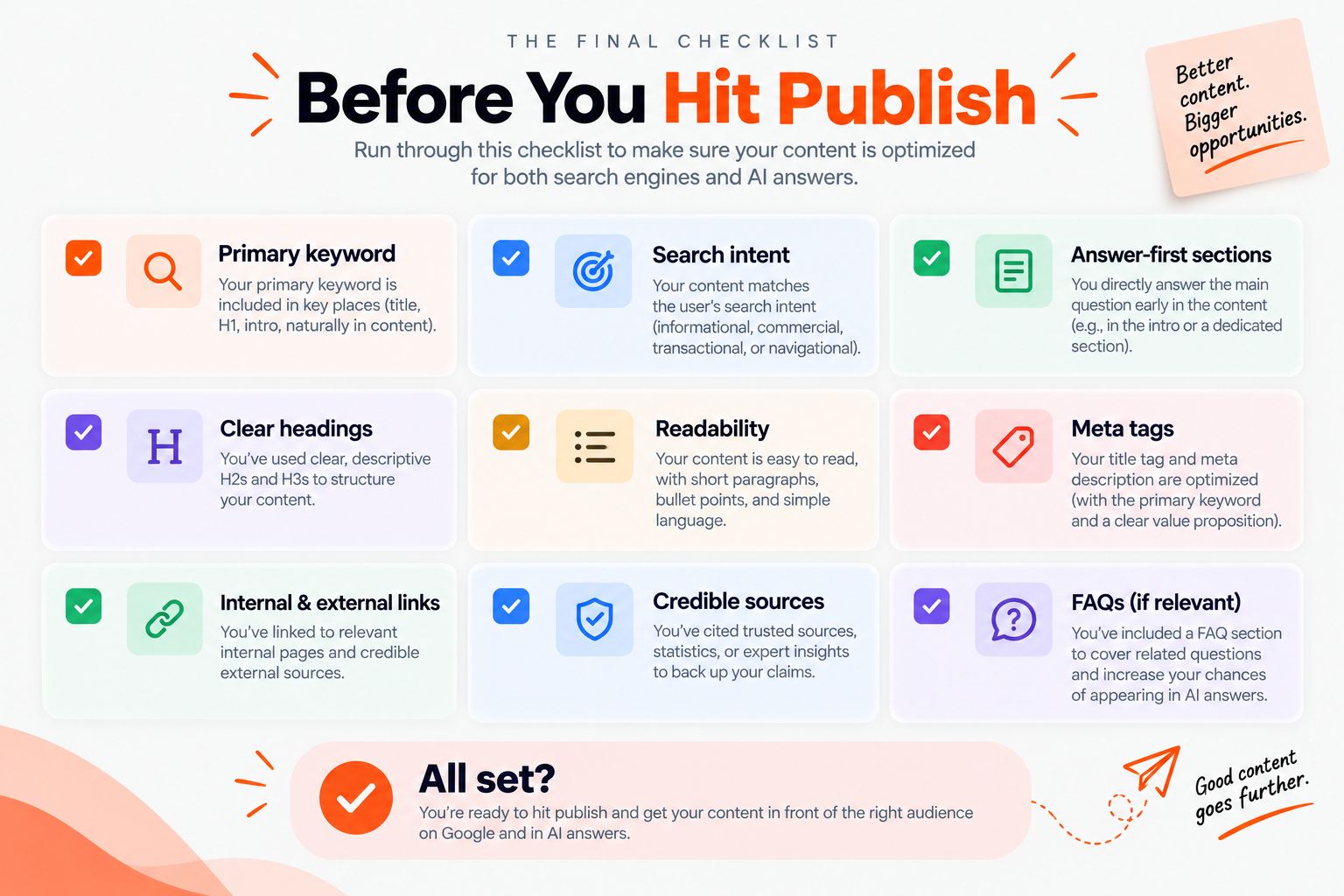
Run every draft through this quick checklist before it goes live.
SEO Content Checklist
- Primary keyword is in the title, intro, one heading, and conclusion.
- Content matches the search intent of the top results.
- Each section opens with a direct, answer-first sentence.
- Headings are clear and describe what follows.
- Paragraphs are short, and the page is easy to skim.
- Title tag, meta description, and URL slug are optimized.
- Internal and external links are added where useful.
- Claims are backed by experience or credible sources.
- A few FAQs answer real reader questions.
Key Takeaways
- SEO content earns rankings on Google and citations in AI answers.
- Start with keyword research and search intent, always.
- Lead with the answer, then support it with detail.
- Keep keyword density natural, around 1 to 2 percent.
- Structure everything with clear headings and short paragraphs.
- On-page writing gets you ranked. Placement on trusted third-party pages gets you cited.
Final Thoughts on How to Write SEO Content
Learning how to write SEO content comes down to one habit. Answer a real question better than anyone else, then structure that answer so both Google and AI engines can use it.
Follow the steps. Research first, write answer-first, keep it clean, and format for both readers and machines. Do that consistently and your pages will rank and get quoted.
And when you are ready to show up in the AI answers your competitors already own, remember that citations come from the pages engines trust. Getting placed on those pages is where a partner like Anchorial comes in.
Frequently Asked Questions (FAQs)
What is SEO content writing?
SEO content writing is the process of creating content that ranks in search engines and answers a specific search query. It blends helpful writing with optimization, so people and search engines can both find and trust it.
How do you write SEO content step by step?
You research keywords, match search intent, outline the topic, write an answer-first draft, place keywords naturally, structure with headings, optimize your meta tags, add links, then edit for quality. Follow those steps in order for every piece.
How long should SEO content be?
There is no fixed length. Match the depth of the top-ranking results for your keyword. Many guides land between 1,500 and 2,500 words, but full coverage and quality matter more than word count.
What is a good keyword density for SEO?
Aim for around 1 to 2 percent. Use your primary keyword once every 150 to 200 words, mixed with secondary keywords, and only where it reads naturally. Forcing keywords hurts more than it helps.
How to write SEO content for beginners?
Start small. Pick one primary keyword, study the top results, write a clear answer-first draft, and add headings. You do not need every advanced tactic to publish a page that ranks.
What is the difference between SEO writing and regular content writing?
Regular writing focuses on whether the content is good. SEO writing adds a second test. It checks whether the content is the best answer to a specific search and whether it is structured to be found.
How to write content that gets cited by AI tools like ChatGPT?
Lead with a direct answer, write clear quotable sentences, use real data, and structure each section to stand alone. AI engines pull from content that is easy to extract and easy to trust.
Do meta descriptions affect SEO rankings?
Meta descriptions are not a direct ranking factor. They do influence click-through rate. A strong meta description earns more clicks, and higher engagement can support your rankings indirectly.
What is search intent and why does it matter?
Search intent is the reason behind a query. It matters because Google ranks pages that match what searchers actually want. Miss the intent, and even brilliant writing will struggle to rank.
How often should you update SEO content?
Review important pages every six to twelve months. Search results, facts, and competitors change over time. Refreshing content with current information helps you hold rankings and stay citable.
Can you write SEO content without paid tools?
Yes. Free tools like Google People Also Ask, related searches, and Google Search Console cover the basics. Paid tools like Ahrefs and Semrush make research faster, but they are not required to start.