You published the guest posts. You paid for the placements. Six months later, your rankings look exactly the same.
Here is a reason nobody pitches you: links do not stay put. Ahrefs sampled above 2 million websites and found 66.5% of the links pointing to them since 2013 had rotted. Add temporary errors and other faults, and 74.5% were effectively lost. Most of what you buy quietly disappears.
Authority backlinks are different. They sit on sites Google and AI systems already trust, sites that will still be there in three years, and they compound rather than decay. The industry just trained you to spot them using a number anyone with a budget can fake.
This guide covers what actually counts, how to qualify a prospect before you burn three weeks on outreach, what these links cost, and which tactics deserve your time.
What are Authority Backlinks?
An authority backlink is a link from a site that search engines and AI systems genuinely trust.
Google has treated links as votes since the beginning. When a respected site links to you, it vouches for you. That vote transfers credibility, and credibility ranks.
Here is where most people go wrong. They assume a high Domain Rating equals a real vote. It does not.
Think about a recommendation from a colleague who has worked with you for five years, against one from a stranger paid twenty dollars to say something nice. Both are endorsements. Only one carries weight.
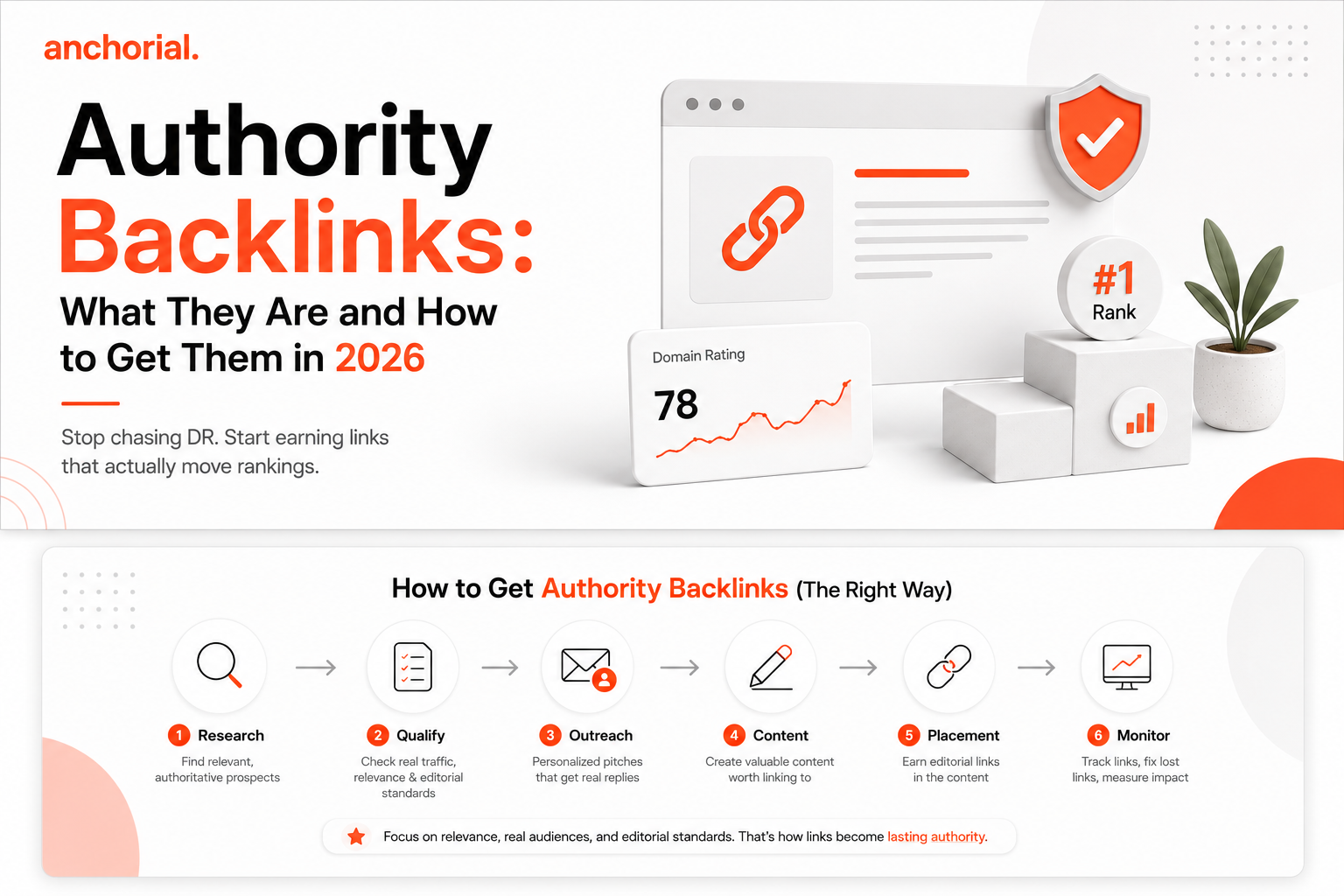
A real authority link clears five bars:
- It sits on a domain with a genuine audience, not just a strong-looking metric
- It is topically coherent with what you do
- It is placed editorially, inside the content, with natural text around it
- It comes from a publication with real editorial standards
- It stays live and keeps getting crawled
A link that only clears the metric test looks good in a report and does nothing in the SERPs.
How Authority is Actually Measured
Three metrics dominate: Domain Rating from Ahrefs, Domain Authority from Moz, and Trust Flow from Majestic. All three estimate how much of the web’s trust graph points at a domain.
DR is the most widely used, and it works as a rough signal. Ahrefs studied the correlation between DR and keyword rankings across 218,713 domains and found the two correlate well.
So why not filter by DR and start pitching? Because DR is a proxy, not the thing itself. Proxies can be gamed.
Why High Authority Backlinks Cannot be Judged on DR Alone
Nathan Gotch, founder of Gotch SEO Academy, is blunt about it. Shady vendors buy expired domains, create fake keywords, and artificially inflate organic traffic. On the surface, the opportunity looks good. Underneath, it is a glorified PBN with a nice number attached.
The scale is measurable. A survey found 85.3% of guest posting sites are low quality, defined as DR under 40 with fewer than 10,000 monthly organic visitors. Six out of seven opportunities you get pitched will fail a basic sniff test.
Ahrefs says it on their own tool page: never judge a website on site-wide authority alone. Google cares more about the strength of the linking page than the domain.
DR gets you a shortlist. It does not get you a decision.
Why Authority Backlinks Still Matter in 2026
Rankings. Referring domains to a page is the strongest correlating backlink factor for rankings, based on Ahrefs’ analysis of roughly 920 million pages.
Referral traffic. A link on a page real people read sends real people to you, whether or not Google ever notices.
Credibility. When a prospect sees you cited in a publication they already read, your sales cycle gets shorter.
AI visibility. This one needs honesty.
The Honest Part About AI Search
Ahrefs analyzed 75,000 brands to find which factors predict visibility in AI Overviews. Brand web mentions correlated at 0.664. Backlinks came in at 0.218.
Mentions correlate roughly three times more strongly than links. The top three factors were all off-site brand signals: web mentions, brand anchors, and brand search volume.
Ahrefs flags the caveat, and so should you. Correlation is not causation. Large brands get mentioned more and appear in AI answers more, so brand strength may be driving both.
The takeaway still holds. If AI visibility is your goal, chasing links alone is the wrong bet. The good news: digital PR earns links and mentions at the same time. You are not choosing between them.
Key takeaways
- Authority backlinks come from sites with real audiences and real editorial standards, not just high scores.
- DR correlates with rankings but is easy to manipulate, so use it to filter prospects, never to pick them.
- 85.3% of guest posting sites fail a basic quality bar (DR under 40, under 10,000 monthly visitors).
- For AI Overview visibility, brand mentions correlate roughly 3x more strongly than backlinks: 0.664 against 0.218.
- Referring domains, not raw link count, is the number that moves rankings.
How to Qualify a Link Prospect Before You Pitch
This is the section almost nobody writes, and it saves the most time. Run every prospect through these five checks before you spend a minute on outreach.
1. Traffic against page count
Pull the site into Ahrefs. If it has 400 published pages and 800 monthly organic visitors, something is broken. Real publications earn traffic in proportion to what they publish. A big library with no readers means the content exists to host links, not readers.
2. Link velocity
Look at the referring domains graph over time. Healthy sites accumulate links gradually. A flat line followed by a vertical spike means someone bought their way up, and Google devalues those as spam detection improves.
3. Outbound link patterns
Open five recent posts. Who are they linking to? If the same blog links out to crypto, dental, and SaaS companies in one week, you are looking at a link farm with a theme painted on top.
4. Does it rank for anything?
Check the site’s top organic keywords. If a DR 65 site ranks for nothing meaningful, Google is already discounting it. Why would a link from it help you when it is not helping them?
5. Topical fit
Would this site’s readers plausibly care about your product? Gotch has a one-question filter that kills most bad prospects instantly: could this link realistically send us traffic or drive a conversion? If the honest answer is no, skip it.
Pro tip: Run the checks in this order. Traffic against page count kills the most prospects fastest, so doing it first means you never open the other four tabs.
How to Get Backlinks from High Authority Sites
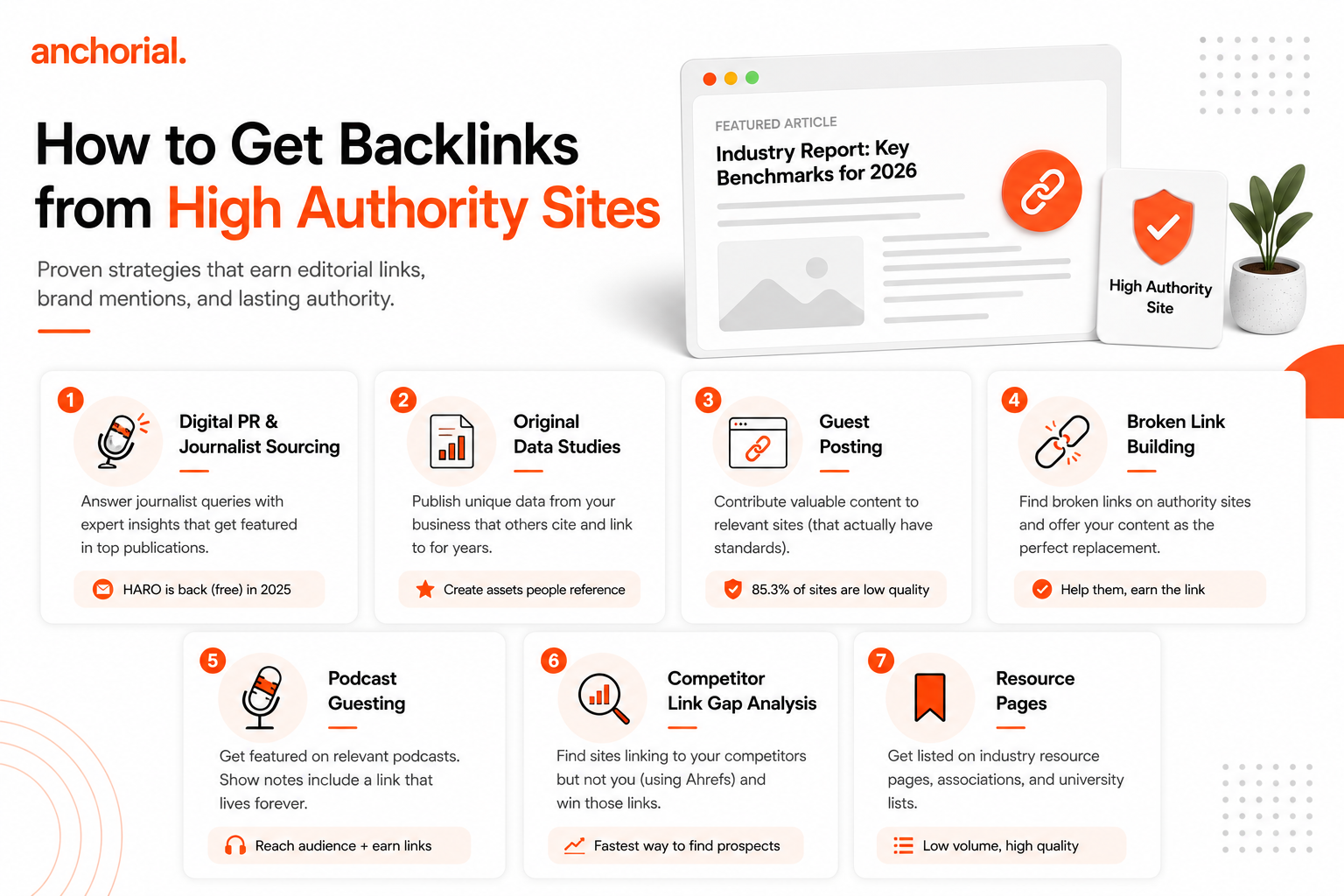
Digital PR and journalist sourcing
Journalists need expert quotes on deadline. You have expertise. That trade earns editorial links from publications you could never buy your way into.
The platform landscape confuses people, so here is the current state. HARO shut down in December 2024 under Cision. Featured.com acquired it and relaunched it for free in April 2025, back in its original daily email digest format with no paid tiers. In May 2026, Featured revived the Connectively brand alongside it. Both are live. Most guides on this topic still describe the Cision-era paid version that no longer exists.
Example: a founder answers a query about churn benchmarks with a real number from their own product data. The journalist uses it because nobody else supplied a figure. One email, one editorial link, one brand mention.
Original data studies
Publish a number nobody else has, and people cite it for years. You do not need a survey budget. Pull it from what you already own. One HR software company analyzed 100 job descriptions for a single role and turned it into a report on in-demand skills. Cost: a few hours. It earns links every time someone writes about the topic.
Guest posting
Still works, but only against the checks above. Remember that 85.3% of inventory is junk. Read three of their recent posts, pitch a topic they have not covered, and place the link where it helps the reader.
Broken link building
Find dead outbound links on relevant high authority sites, then offer your content as the replacement. It works because you are doing the owner a favour rather than asking for one. A major marketing blog links to a statistics page that now 404s. You have a live, better version. Their reader stops hitting a dead end, and you get the link.
Podcast guesting
Show notes live forever and usually include a link. You also reach the audience directly, which a guest post rarely does. One SaaS founder skipped content marketing entirely and focused on podcast appearances, which drove qualified customers and show-note links at once.
Competitor link gap analysis
The fastest source of qualified prospects. Drop your top three competitors into Ahrefs, filter for their highest-DR topically relevant referring domains, and find sites linking to two or more of them but not to you. A site that already links to several competitors has proven it will link to a company like yours.
Resource pages
Industry associations, university departments, and niche curators maintain lists of useful tools. If your product genuinely belongs on one, ask. Low volume, high quality, almost no effort.
Effort against payoff, ranked
| Tactic | Time per link | Cost per link | Success rate | Verdict |
| Competitor link gap | Low | Tool cost only | Prospecting, not pitching | Start here. It feeds every other tactic. |
| Resource pages | Low | Free | Low volume, high hit rate | Quick win if you genuinely belong on the list. |
| Broken link building | Medium | Free | Medium | Reliable. You are doing them a favour, not asking one. |
| Podcast guesting | Medium | Free | High once booked | Underrated. Show notes live forever. |
| Guest posting | Medium | $220 to $609 | Medium | Only after qualifying. Most inventory is junk. |
| Digital PR | High | $750 and up | Low per pitch | Highest ceiling. Earns links and mentions together. |
| Original data study | Very high upfront | Varies | Compounds over the years | Best long-term asset you can build. |
What Authority Backlinks Cost and How Long They Take
A survey found 518 SEO professionals, of whom 412 answered the pricing question; the average price they consider acceptable for one high-quality backlink was $508.95.
Note the wording. That is what SEOs are willing to pay, not what links cost. Ahrefs’ analysis of paid placements puts the average nearer $361, excluding labour. Anyone quoting $508.95 as the going rate is misreading a survey.
Realistic ranges by tactic:
- Guest post: around $220 on average, up to roughly $609 for a quality placement
- Link insertion or niche edit: around $141
- Digital PR: around $750 per link and climbing from there
On timing, 57.1% of surveyed SEOs expect results within one to three months. Treat that as optimistic. Plan for three to six, and expect the compounding effect of eight to fifteen good links to be where movement shows up. One more number worth budgeting around: 80.9% believe link building will get more expensive over the next two to three years.
Tactics to Avoid
Buying link bundles. The cheapest links are cheap because nobody reads the sites they sit on. You are paying for a line in a report.
PBNs. Private blog networks are exactly what the five checks catch. If you can spot them in ten minutes, so can Google.
Link swaps. You link to me, I link to you. Overused, it reads as manipulation, and Google has been detecting patterns like this for a very long time.
Chasing DR as the goal. Ahrefs is explicit that improving your authority score should never be your primary goal. Earn links to the pages you want to rank and let the score follow.
Trusting undated advice. HARO is the perfect example. A tool died, came back under new ownership, and got renamed alongside a revived sister brand, all inside eighteen months. Check the date on any guide before you act on it.
How to Track Results
Stop counting links. Count referring domains. One site linking to you fifty times is one vote, not fifty, which makes referring domains the only link number worth putting on a dashboard.
Track four things:
- Referring domains to your target pages, measured monthly
- Referral traffic from each placement, visible in analytics within days
- Ranking movement for two or three target keywords, expected at three to six months
- Brand mentions, linked and unlinked, since those are what AI systems weigh most heavily
Things to remember before you go
- Qualify before you pitch. Five minutes in Ahrefs beats three weeks of outreach aimed at a dead site.
- One link from a site with real readers beats ten from sites with none.
- Budget $300 to $600 for a legitimate editorial placement, and $750 or more for digital PR.
- Expect movement at three to six months, not three weeks.
- Chase mentions alongside links. AI systems weigh them roughly three times more heavily.
FAQs
How many authority backlinks do I need to rank?
There is no universal number. What matters is how your referring domain count compares to the pages already ranking for your target keyword. Pull the top three results into Ahrefs, look at referring domains to those specific pages rather than the whole site, and use that as your benchmark.
Are high authority backlinks worth paying for?
Paying for content creation and outreach is normal and expected. Paying a vendor directly for a placement carries risk, and the risk rises as the price falls. If you do pay, run the five qualification checks first, because most of what is for sale fails them.
How long before authority backlinks affect my rankings?
Most campaigns show movement between three and six months. A single link rarely does anything visible on its own. The compounding effect of eight to fifteen quality links over six months is where the change shows up.
Do backlinks still matter now that AI search is growing?
Yes, but less exclusively than they used to. Ahrefs found brand mentions correlate with AI Overview visibility at 0.664 against 0.218 for backlinks. Links still drive traditional rankings, mentions drive AI visibility, and digital PR produces both. That dual return is why it justifies the higher cost.
The Bottom Line
Authority backlinks are still one of the strongest signals you can build. What changed is that you can no longer identify them with a metric.
The teams winning are not the ones sending the most outreach. They are the ones qualifying prospects before they pitch, earning links from publications with actual readers, and treating brand mentions as part of the same job.
Start with your competitor link gap. Run the five checks. Pitch fewer sites, better.