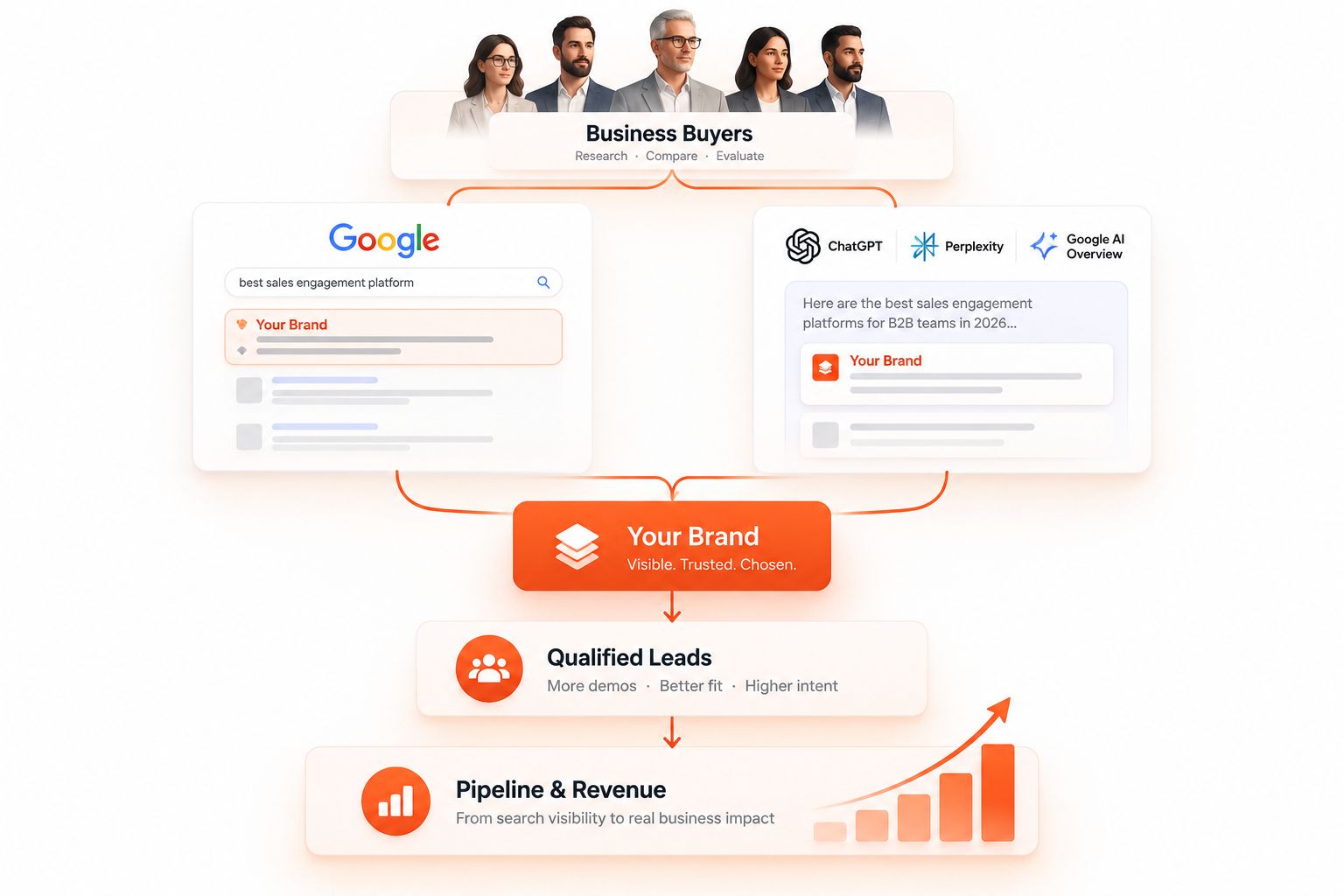
B2B SEO is the practice of optimizing your site and content so business buyers find you in search, on Google and inside AI answers. The goal is not traffic. The goal is pipeline.
Here is what changed. Your buyers stopped scrolling through ten blue links. They ask ChatGPT. They skim the Google AI Overview. They check Perplexity before they ever talk to sales. If your brand is missing from that answer, you never make the shortlist.
So the old approach, publish a post and hope it ranks, is done. What works now is B2B SEO built for how business buyers actually search in 2026.
This guide gives you the whole picture. What B2B SEO is, how it differs from B2C, the pillars that hold it together, a step by step strategy, and where AI search fits. Every section stands on its own, so jump to what you need.
What Is B2B SEO?
B2B SEO is search engine optimization aimed at business buyers rather than individual consumers. It helps your pages rank for the terms decision-makers use at work, then turns those visitors into qualified leads.
The mechanics match any SEO. Keywords, content, technical health, and links. Google does not run a separate algorithm for business websites. What changes is the audience and the intent.
A B2B buyer is rarely one person. It is a committee. Five to seven stakeholders often shape a single purchase, and the cycle can run for months. Your content has to serve all of them, from the analyst running early research to the executive who signs off.
That is why B2B SEO rewards depth over volume. One page that answers a buyer’s real question can drive more revenue than ten that chase clicks.
B2B SEO vs B2C SEO: What Actually Differs
B2B SEO and B2C SEO follow the same rules but play different games. B2C chases high volume and fast, emotional decisions. B2B targets a small, high-intent audience making a slow, researched call.
Here is the difference at a glance.
Why does this matter? A term with 200 searches a month can outperform one with 20,000 if it reaches the right buyer at the right moment. In B2B SEO, relevance beats reach every time.
Why B2B SEO Is Different in 2026
B2B SEO in 2026 runs on two search surfaces, not one. You are optimizing for Google rankings and for the AI engines your buyers now trust.
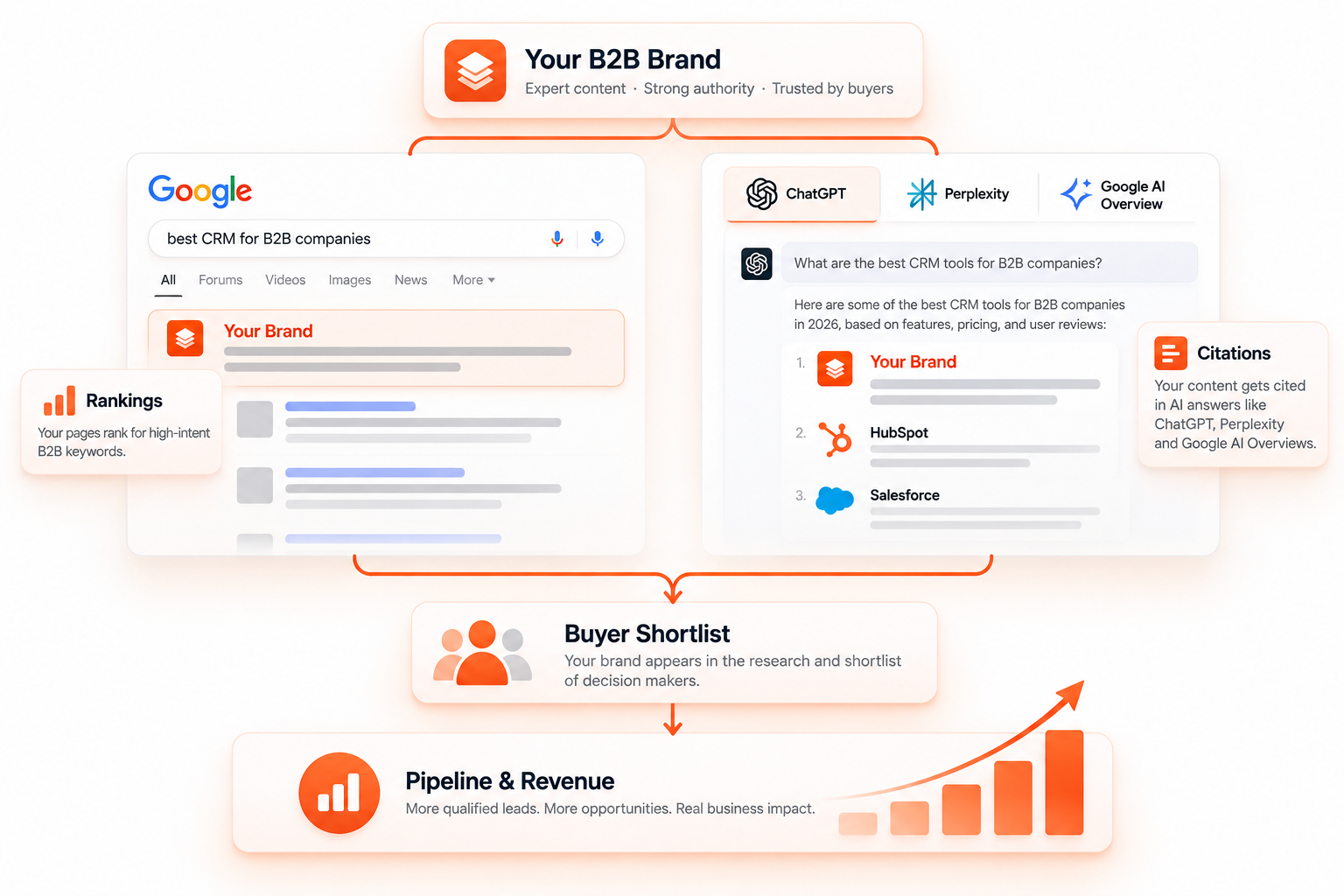
Three shifts define the year:
- Buyers use AI first. Many decision-makers open ChatGPT or Perplexity before Google. The AI answer shapes their shortlist before a single click.
- Low volume, high intent wins. Business keywords are searched less but convert far better. Chasing big numbers pulls you toward the wrong traffic.
- Pipeline is the scoreboard. Rankings and sessions look nice. Revenue is what your CFO asks about. Modern B2B SEO ties the work to leads and deals.
The teams winning right now stopped treating AI search as a side project. They build for both engines at once, because the same authoritative content that ranks on Google is what AI models pull into their answers.
The 4 Pillars of B2B SEO
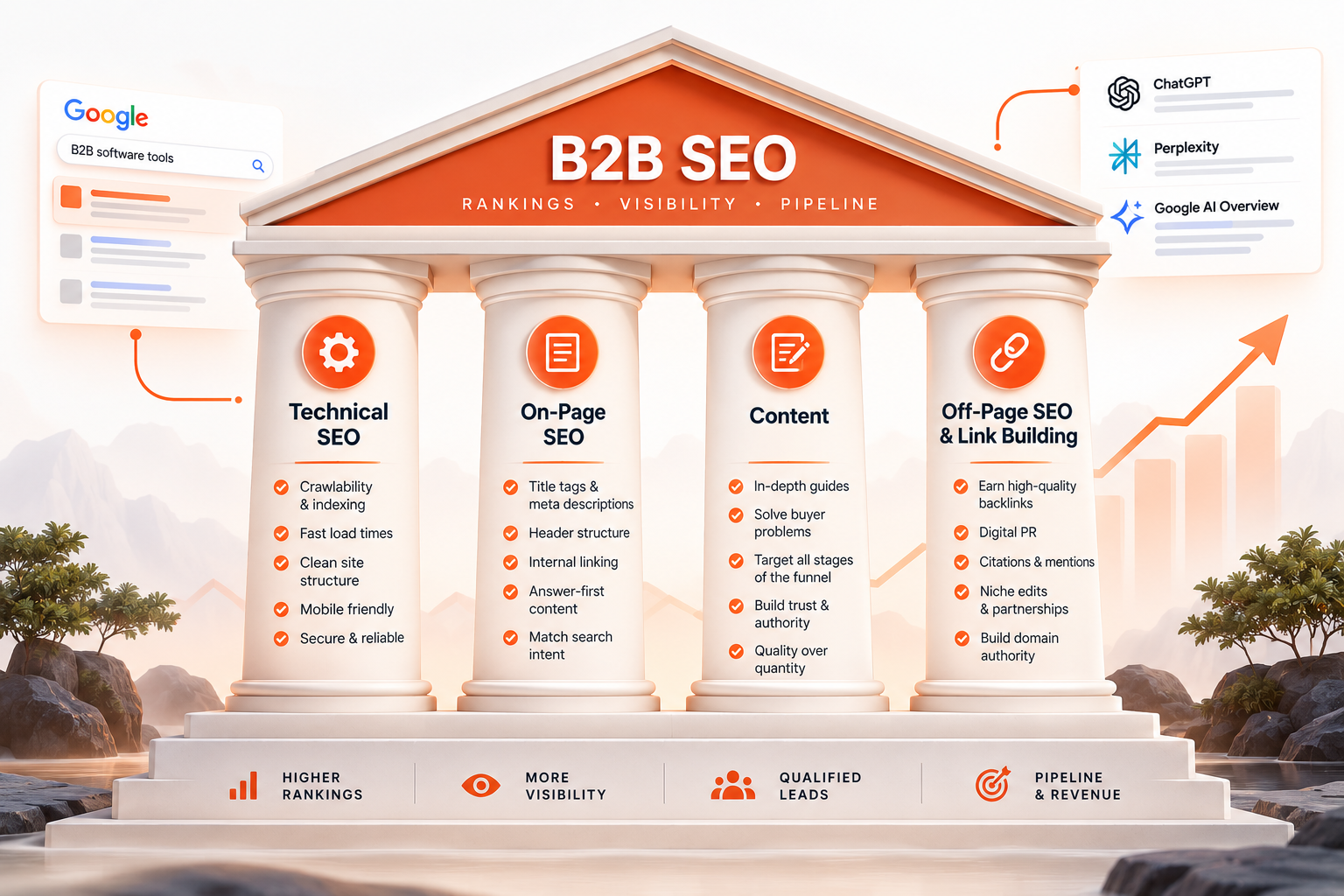
Every strong B2B SEO strategy stands on four pillars. Miss one and the whole thing wobbles.
1. Technical SEO
Technical SEO is the foundation. It makes sure search engines can crawl, read, and index your site. Fast load times, clean site structure, mobile-friendly pages, and a logical URL setup. Get this wrong and nothing else ranks.
2. On-Page SEO
On-page SEO is the optimization of each page itself. Title tags, meta descriptions, headings, internal links, and answer-first content. This is where you match a page to a specific search and its intent.
3. Content
Content is how you earn trust across a long buying cycle. You need top of funnel guides for early research, middle of funnel comparisons for evaluation, and bottom of funnel proof like case studies for the decision.
4. Off-Page SEO and Link Building
Off-page SEO is the authority you earn from other websites. Backlinks are still one of Google’s strongest trust signals, and they now shape which sources AI engines cite too.
This is the pillar most B2B teams underinvest in, because it is the hardest to do yourself. Earning links on the publications your buyers already read takes outreach, relationships, and consistency. It is also where a specialist partner like Anchorial does the heavy lifting, placing your brand on high authority pages instead of leaving you to chase links one email at a time.
How to Build a B2B SEO Strategy Step by Step
A B2B SEO strategy is a system, not a checklist. You research, you plan, you publish, then you build authority and measure. Follow these steps in order.
Step 1. Map Keywords to Buying Stages
Start with intent, not volume. Group keywords by where the buyer sits.
- Awareness. Broad problem searches like “how to reduce churn.”
- Consideration. Solution searches like “customer retention software.”
- Decision. Vendor searches like “best retention tools” or “[competitor] alternative.”
Use Ahrefs or Semrush to check volume and difficulty, then favor terms real buyers use.
Step 2. Match Search Intent and Format
Look at what already ranks before you write. If the top results are comparison posts, write a comparison. Fighting the dominant format is a losing bet. The SERP is telling you what Google thinks the searcher wants.
Step 3. Build Content for the Whole Funnel
One post does not close a B2B deal. Buyers read several pieces per vendor before they reach out. Cover the full journey, then link the pieces into topic clusters so they build authority as a group.
Step 4. Nail Technical and On-Page Basics
Fix crawl issues, speed, and structure first. Then optimize each page. Lead with the answer, use clear headings, and place your primary keyword in the title, intro, one heading, and the close.
Step 5. Build Authority With Links
Rankings stall without off-page signals. Earn backlinks and brand mentions on trusted sites in your space. This is slow, compounding work, and it is often where B2B SEO agencies or a placement specialist add the most value.
Step 6. Measure Against Pipeline
Track rankings and traffic as leading indicators. Track leads, MQLs, and pipeline as the real result. If a page ranks but never produces a lead, it is not doing its job.
B2B SEO and AI Search: The New Visibility Layer
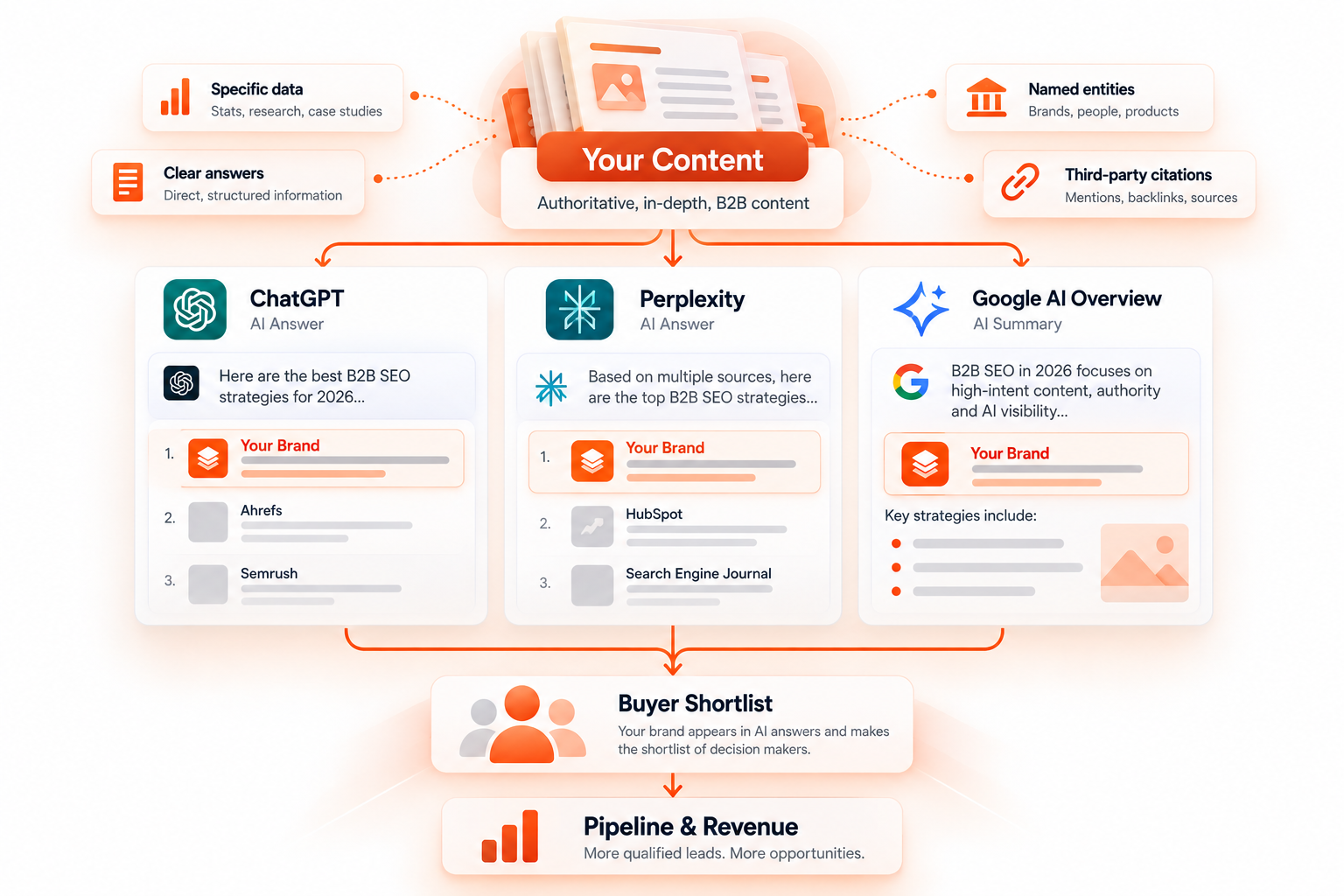
AI search visibility is now a core part of B2B SEO, not a bonus. When a buyer asks ChatGPT, Perplexity, Gemini, or Google’s AI Overviews for the best option in your category, you are either named or you are invisible.
This discipline has a few names. AEO, answer engine optimization. GEO, generative engine optimization. The goal is the same. Be the source the AI answer cites.
Here is why it matters for B2B. Around 94% of business buyers now use AI in their buying process, and many rank it their most trusted research source. The AI answer is the new first impression, and it forms before your website ever loads.
Optimizing for AI search overlaps with good B2B SEO, but it rewards slightly different moves:
- Lead with the answer. Give a clean, quotable response near the top of each section.
- Write self-contained blocks. Each section should make sense on its own, so an engine can lift it.
- Use real numbers and named entities. Mention specific tools, brands, and data. Models trust specificity.
- Earn third-party citations. AI engines pull heavily from pages other than your own.
That last point is the one most guides skip. And it changes everything about how you plan.
The Honest Limit of On-Site B2B SEO
Here is what most B2B SEO advice will not tell you. Perfect on-site work has a ceiling.
AI engines mostly cite third-party pages, not your own site. When a buyer asks for the best tool in your category, the answer comes from roundups, comparisons, and listicles that mention you. Around 88% of pages cited by AI engines do not even rank in Google’s top 10.
So your own content gets you ranked. Getting cited depends on being present on the external pages those engines already trust. That is a different job from writing, and it is easy to ignore until a competitor owns every AI answer in your space.
This is exactly the gap Anchorial was built to close. Instead of handing you another dashboard, Anchorial finds the pages ChatGPT, Perplexity, and Google AI Overviews already cite for your buyer queries, then gets your brand added to them. Pricing is per placement, starting at $400, so you pay for being added to a cited source, not for a report that repeats what you already know.
Think of it as the off-page half of B2B SEO, done for you.
How to Measure B2B SEO Success
Measure B2B SEO by pipeline, not vanity metrics. Traffic and rankings are signals along the way. Leads and revenue are the point.
Track these in two tiers:
- Leading indicators. Keyword rankings, impressions, indexed pages, and long-tail growth. These move first, often within 60 to 90 days.
- Business results. Organic leads, MQLs, SQLs, and pipeline influenced by organic. These are what prove the program works.
Give it time. Most B2B SEO shows early movement in three months and meaningful pipeline around months four to six, with the biggest gains after a year of steady work.
Common B2B SEO Mistakes to Avoid
Most B2B SEO fails for the same few reasons. Dodge these and you are already ahead of most of your market.
- Chasing volume over intent. A big number feels good. A page that ranks for a term no buyer searches drives zero pipeline.
- Writing for keywords, not people. Search engines are not your customer. The buying committee is.
- Quitting too early. The work compounds. Most teams pull the plug right before the payoff, around month three.
- Ignoring off-page work. Great content with no authority stalls. Links and mentions are what push you into rankings and AI answers.
- Measuring traffic, not pipeline. Sessions do not pay salaries. Track leads and revenue instead.
When to Hire a B2B SEO Agency
Hire a B2B SEO agency when the work outgrows your team’s time or skill. Most in-house teams can handle content and basic on-page work. The technical depth, link building, and AI visibility work is where outside help pays off.
Before you sign with any of the B2B SEO companies on your shortlist, ask them these questions:
- Do you execute, or only report? An audit is not a result.
- Is your pricing transparent? It should map to a clear deliverable.
- Do I approve every target? You should sign off on domains before work starts.
- What is guaranteed? Ask what happens if a link or placement drops.
- Can you show proof? Look for a real framework and results, not buzzwords.
Match the partner to your gap. If your pages are weak, you need content and on-page help. If you rank fine but never appear in AI answers, you need authority and placements. That second gap is where Anchorial fits, since it combines SEO, AEO, and link building and places your brand on the exact pages AI engines cite.
Win Both Google and AI Search With Anchorial
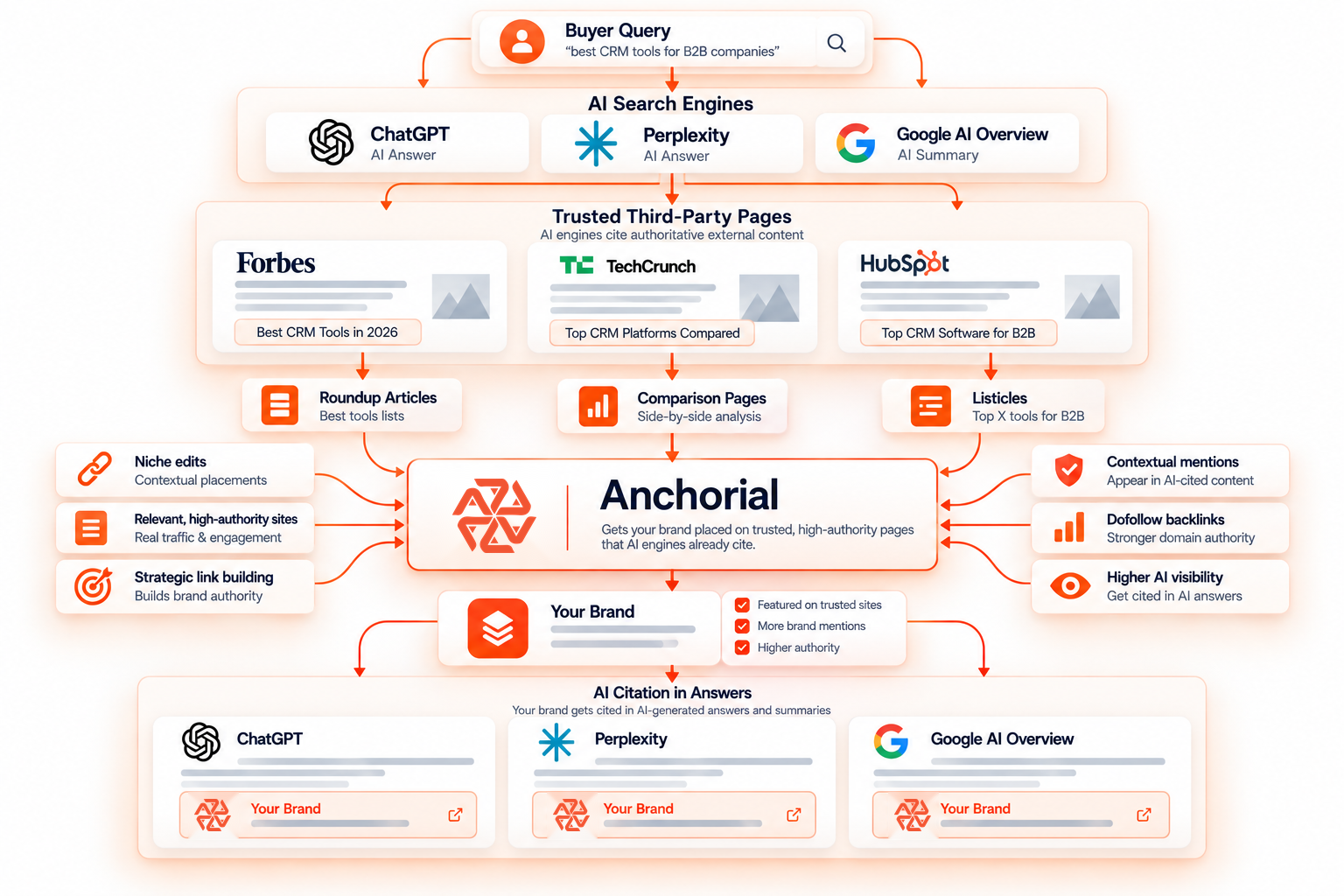
B2B SEO in 2026 is a two-front game. You need to rank on Google and get cited in AI answers, and the second half depends on authority you earn off your own site.
That is where Anchorial comes in. Anchorial is a link building, AEO, and SEO agency that gets your brand added to the pages ChatGPT, Perplexity, and Google AI Overviews already cite. Every placement carries a lifetime guarantee, and pricing starts at $400 per placement, so you pay for outcomes, not another monthly report.
If you are tired of watching weaker competitors get named in AI answers while you sit them out, that is the gap Anchorial closes.
Frequently Asked Questions
What is B2B SEO?
B2B SEO is the practice of optimizing your website and content to reach business buyers through search. It targets the high intent keywords that decision makers and buying committees use, then converts that organic traffic into qualified leads and pipeline.
How is B2B SEO different from B2C SEO?
B2B SEO targets a small, high intent audience making a considered, multi stakeholder decision. B2C SEO targets a broad audience making fast, often emotional choices. B2B keywords have lower volume but higher commercial value, and the content has to educate across a longer sales cycle.
How long does B2B SEO take to work?
Most B2B SEO programs show leading indicators like rankings and impressions within 60 to 90 days. Organic leads usually arrive around months three to six. Strong, compounding pipeline tends to land after 12 to 18 months of consistent work. New domains take longer than established ones.
How much does B2B SEO cost?
B2B SEO pricing varies widely. Agencies often charge monthly retainers from a few thousand dollars up, based on hours, content, and markets. Others price per deliverable. Placement specialists like Anchorial price per placement, starting at $400, so you pay for each addition to a cited page rather than a flat monthly fee.
Does B2B SEO still work in 2026 with AI search?
Yes, B2B SEO still works in 2026, but the target moved. Google still drives most organic traffic, while AI engines now shape shortlists before buyers click. The same authoritative content and links that rank on Google also help you get cited in AI answers, so the two reinforce each other.
What are the best B2B SEO companies to hire?
The best B2B SEO company depends on your gap. Full-service agencies suit teams that want strategy, content, and technical work under one roof. If your problem is authority and AI visibility, a specialist like Anchorial, which combines SEO, AEO, and link building, is a more direct fix. Always match the partner to the specific gap in your search presence.
How many keywords should a B2B SEO strategy target?
There is no fixed number. Focus on one primary keyword per page, supported by close secondary terms. A healthy B2B SEO strategy grows into clusters of related pages over time, each targeting a specific buyer question, rather than one page chasing dozens of unrelated terms.
How do you measure B2B SEO success?
Measure B2B SEO by pipeline, not just traffic. Use rankings, impressions, and indexed pages as early signals. Then track organic leads, MQLs, SQLs, and influenced pipeline as the real proof. A page that ranks but never generates a lead is not succeeding, no matter how much traffic it pulls.