Buying Backlinks in 2026: How to Do It Safely Without a Google Penalty
Buying backlinks works in 2026, but only if you buy the right kind. That is the whole story in one line.
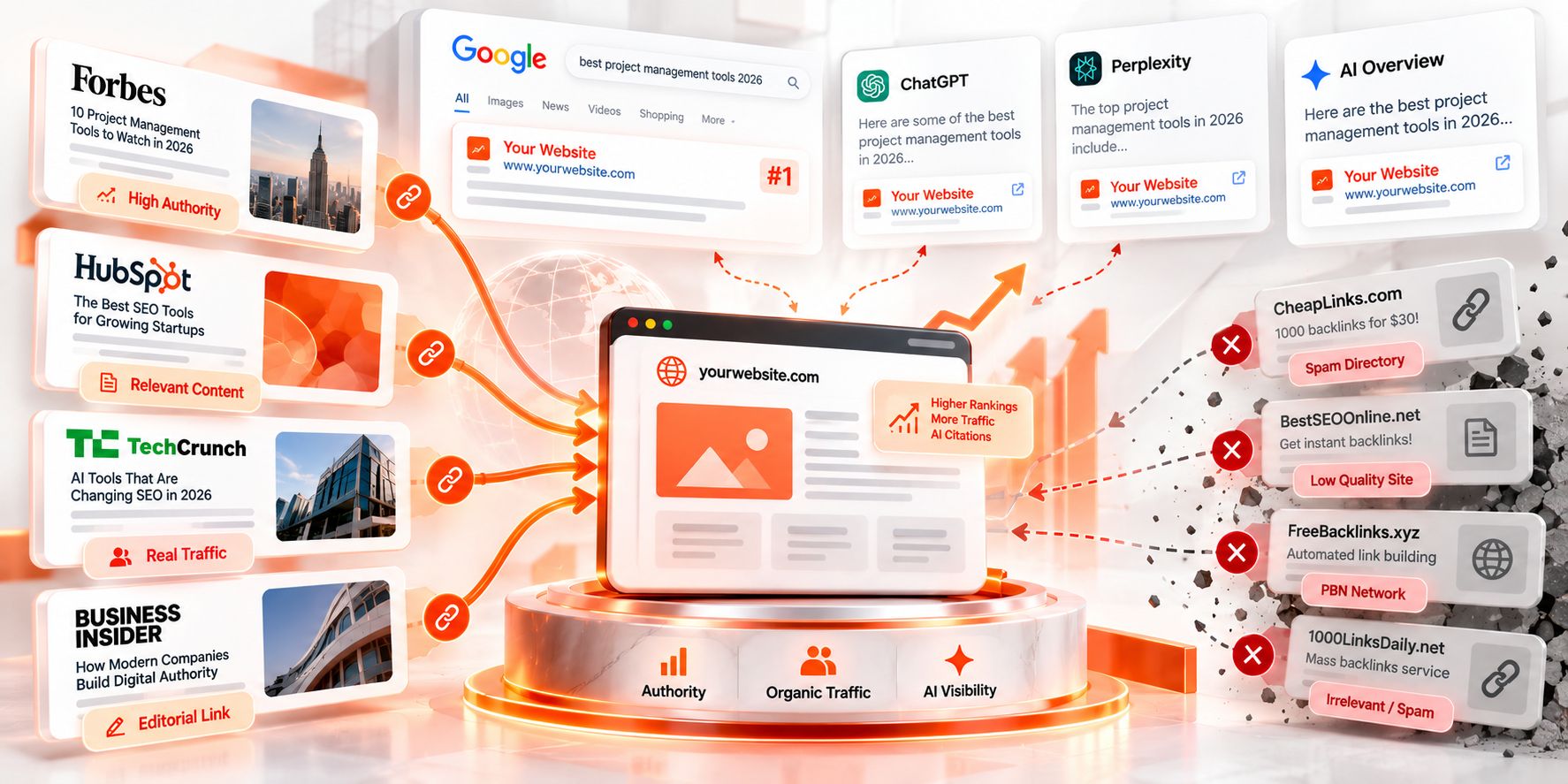
Here is the proof. WebFX studied 1,462 domains across 15 industries this year and found that 92.2% of the backlinks pointing to top-ranking sites were editorial links. Directory links made up 6.8%. Resource links made up just 1.1%. So the links that actually move rankings are earned, editorial placements, not the bulk packages sitting in your inbox.
And backlinks still carry weight. Backlinko's analysis of 11.8 million search results found the number one result has 3.8x more backlinks than positions two through ten. Links matter. Cheap links do not.
That gap is where most people lose their money. They hear that buying backlinks works, grab the $30 package, and wonder why nothing moves. Or worse, why their traffic drops.
This guide fixes that. You will learn whether buying backlinks is safe, what Google actually does about it, the six ways to buy links ranked from reckless to smart, what real links cost in 2026, and how to spot a provider that will burn you. Let's start with the question everyone asks first.
Is Buying Backlinks Safe? The Honest Answer
Buying backlinks is safe when you buy quality, editorial links from real sites, and risky when you buy cheap links in bulk. The safety is not in the act. It is in what you buy.
Think of it like hiring. Paying someone to write your content is normal. Paying a bot to spin 500 junk articles is not. Same money, very different outcome. Buying links works the same way.
Google’s problem was never payment itself. Its problem is manipulation. A paid link on a relevant, trafficked site that adds value to readers looks almost identical to an editorial link. A paid link stuffed into a spammy directory does not, and the algorithm spots it fast.
So the honest answer is this. Yes, you can buy backlinks safely. No, you cannot do it on the cheap.
What Does Buying Backlinks Actually Mean?
Buying backlinks means paying to place a link to your site on someone else's website. A site owner agrees, you pay, the link goes live.
That is the simple version. In practice, buying links takes a few common shapes.
- Guest posts. You pay to publish an article on another site with a link back to yours.
- Niche edits. You pay to insert your link into an article that already exists on a relevant site.
- Sponsored content. You pay to run a labeled sponsored post, usually with a nofollow or sponsored tag.
- Link packages. You buy a bundle of links from a vendor, often at a fixed price per link.
- Agency placements. You pay an agency to earn or place links for you, rather than buying the links directly.
Each one carries a different level of risk and a different price. We will break all of them down in a minute.
Does Google Allow You to Buy Backlinks?
No, Google does not officially allow buying backlinks. Its guidelines classify paid links that pass PageRank as a link scheme, which is against the rules.
But here is what actually happens. Buying and selling links is everywhere. Plenty of respected brands do it. Google's own systems have gotten good enough to tell the difference between a manipulative link scheme and a paid link that sits naturally on a quality site.
The enforcement focus is on patterns, not on every single paid link. Spammy footprints, sudden link spikes, exact-match anchors by the hundred. That is what gets flagged. A handful of quality placements on relevant sites rarely trips anything.
Two things can go wrong when you ignore this.
- You waste money. Links on dead directories or spun forums do nothing. Google already ignores them.
- You get a manual action. A human reviewer flags your site, and your rankings can fall off a cliff. These are rarer now, but they still happen to sites buying obvious spam.
The takeaway. Google says no, the industry says yes, and the deciding factor is quality. Buy links that look and behave like editorial links, and you stay in the safe zone.
The 6 Ways to Buy Backlinks, Ranked by Risk
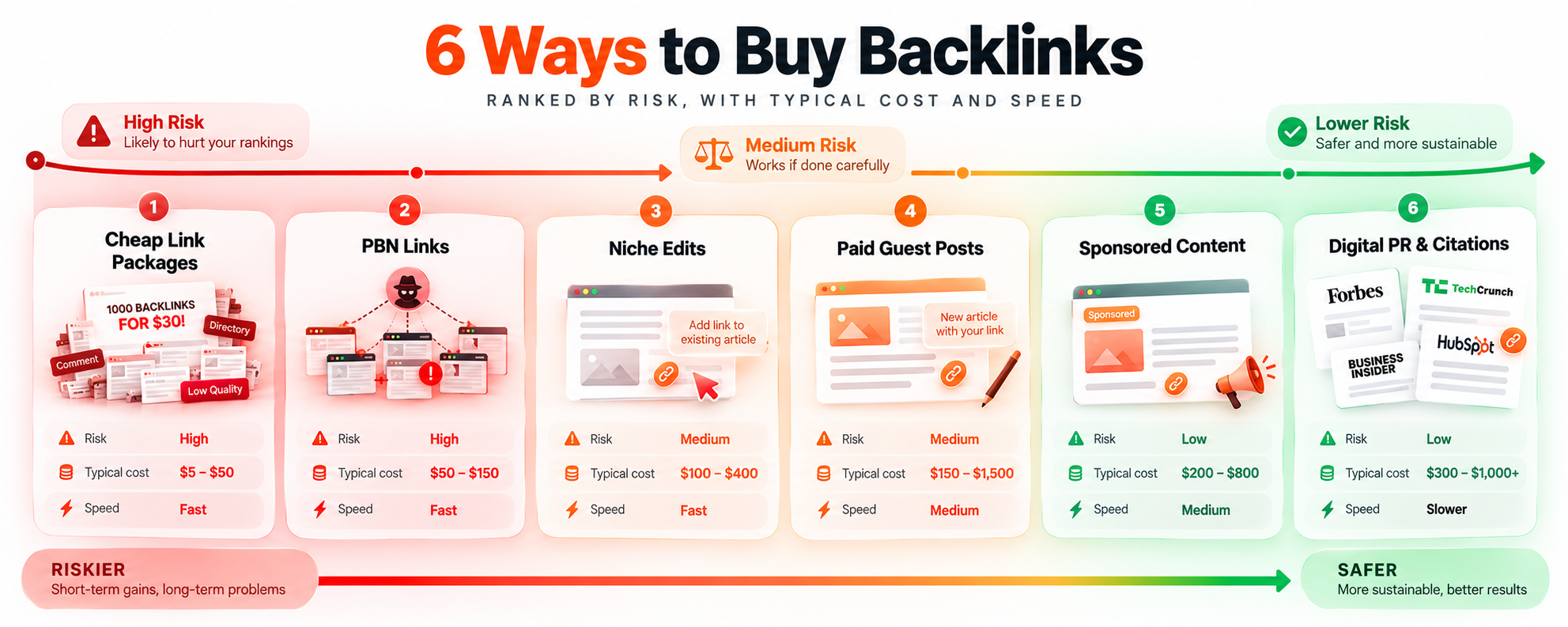
Not every way to buy links is equal. Some are close to safe. Some will sink your rankings. Here is the whole landscape, ranked from worst to best.
Start with this quick view, then read the details below.
1. Cheap Link Packages (High Risk)
The first thing most new site owners find is a cheap package. Buy SEO backlinks cheap: 1,000 links for $30, ranking boost guaranteed. Run.
These buy backlink packages are built on volume, not quality. Auto-generated blog comments, spun content, dead directories. Google either ignores them or, if the footprint is ugly enough, penalizes you.
If a deal sounds too good to be true, it is. Real links cost real money, because real placements take real work.
2. PBN Links (High Risk)
A private blog network, or PBN, is a set of sites one person owns purely to sell links. On paper, the metrics can look strong. That is the trap.
Google hates PBNs and has spent years hunting them down. Buy from one, and you are renting a link on borrowed time. When the network gets deindexed, your rankings can go with it.
Skip these, no matter how good the domain rating looks.
3. Niche Edits (Medium Risk)
Niche edits are when you pay to slip your link into an article that already lives on a relevant site. Because the page is aged and already indexed, the link can work quickly.
The upside is real.
- You choose the site and the page.
- You control the anchor text.
- You get a link on content that already has some trust.
The downside is the company you keep. If a site owner will edit in your link for cash, ask how many others they have done the same for. One relevant, clean placement is great. A page surrounded by unrelated paid links is a red flag.
4. Paid Guest Posts (Medium Risk)
A paid guest post is an article you pay to publish on another site, with your link inside. It shares the perks of niche edits. You pick the site, the content, and the anchor.
The catch is you have to create the article, which adds cost or time. And if you place it on a low-quality site just because it was cheap, you inherit that site’s problems.
Done on a relevant, well-run site, paid guest posts are one of the more reliable ways of buying links.
5. Sponsored Content (Low Risk)
Sponsored content is a labeled paid post, tagged as sponsored or nofollow so Google knows money changed hands. That honesty is exactly why it is safe.
The trade-off is the nofollow tag, which means the link passes little ranking power on its own. What you get instead is brand exposure, referral traffic, and placement on sites that would never take a standard guest post. Sometimes that visibility earns you natural follow links down the line.
6. Digital PR and Citation Placements (Low Risk, Best Value)
This is the one that ages well. Digital PR earns links by giving journalists and publishers something worth citing. A data point, an expert quote, a fresh angle. The result is a dofollow link on a high-authority site, fully white hat.
It is slower and it takes real effort. But the links are the kind Google trusts and, increasingly, the kind AI engines pull from. More on that shortly, because it is where the game is heading.
How Much Do Paid Backlinks Cost in 2026?
Paid backlinks cost between roughly $100 and $1,500 per link in 2026, depending on the method and the site's authority. The days of cheap, bulk buying are gone.
Here is the current market, by link type.
The pattern is simple. The cheaper the link, the less it does, and the more likely it is to hurt you. When you buy backlink packages priced like a fast-food combo, you are paying for links Google already discounts.
Spend less often on better links. One editorial placement on a trusted site beats fifty scattered links every time.
How to Vet a Backlink Provider (Red-Flag Checklist)
Vet a provider before you spend a dollar. The wrong one wastes your budget. The really wrong one gets you penalized. Run every provider through this list.
Ask one question that cuts through any pitch. When your report shows a gap, who actually gets my link onto the page? If the answer is you do it yourself, you are buying a list. If the answer is we do, you are buying a result.
Which Way to Buy Backlinks Fits Your Situation?
The right method depends on where your site stands today. Match the move to your gap.
- New site, thin content. Fix your own pages first, then start with a few relevant guest posts to build a base.
- Ranking on page two, stuck. Niche edits and guest posts on relevant, trusted sites can give pages the push they need.
- Competitive niche, deep pockets. Digital PR and premium guest posts on high-authority publications. This is where the finance and SaaS players live.
- Ranking fine but invisible in AI answers. You need placements on the third-party pages that AI engines already cite. That is a different job, and it is next.
There is no single best way to buy backlinks. There is only the best way for your situation.
Buying Backlinks for AI Search Visibility
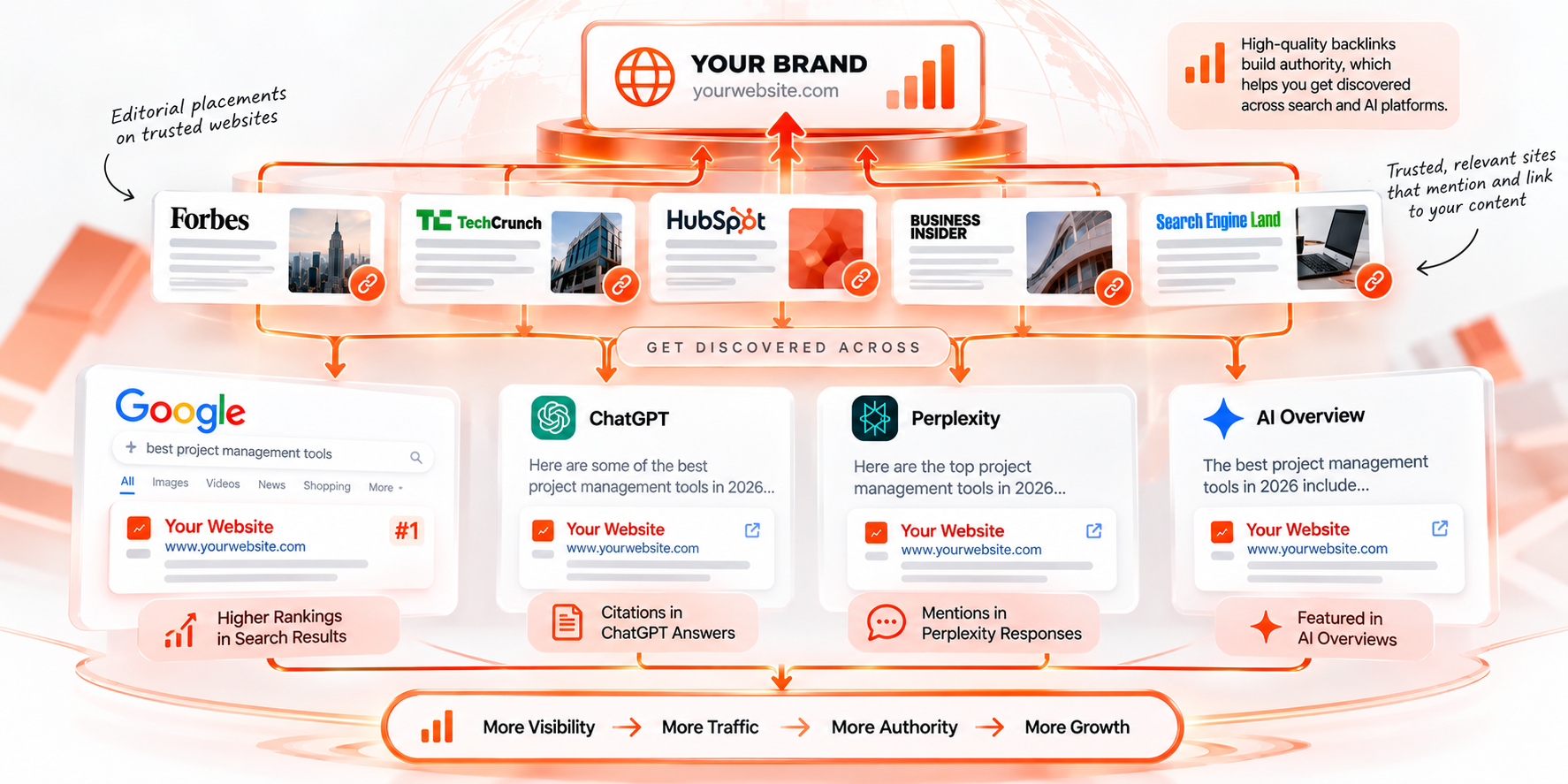
Here is the shift most guides miss. Buying links is no longer just about Google rankings. It is about whether ChatGPT, Perplexity, and Google AI Overviews name your brand in their answers.
Those engines build answers from a small pool of sources they trust. And they lean heavily on third-party pages, roundups, comparisons, and listicles, not just your own site. If your brand is not on the pages they cite, you are invisible in the answer, no matter how well you rank.
Quality links feed this directly. A strong, editorial backlink profile tells these models your brand is credible enough to quote. Cheap, spammy links do the opposite and can push you out of the running entirely.
So the same rule holds, just with higher stakes. Editorial placements on trusted, relevant pages help you rank and get cited. Bulk links do neither.
This is exactly the gap Anchorial closes. Instead of handing you a report that shows where you are missing, Anchorial gets your brand added to the pages ChatGPT, Perplexity, and Google AI Overviews already cite for your buyer queries. Placement, not just a dashboard. If getting into the answer is your goal, that is the work that gets you there.
The Bottom Line
Buying backlinks is not the risk. Buying bad backlinks is. Get that difference, and you have already beaten most people spending money on links.
Skip the cheap packages. Skip the PBNs. Put your budget into editorial placements on relevant, trusted sites, keep your anchors natural, and vet every provider like your rankings depend on it, because they do.
Do that, and buying backlinks becomes what it should be. A fast, safe way to build the authority that ranks you on Google and gets you cited in AI answers.
Frequently Asked Questions
Is it illegal to buy backlinks?
No, buying backlinks is not illegal. It is against Google's guidelines, not the law. The risk is a ranking penalty from Google, not legal trouble. Buy quality editorial links, and you stay in the safe zone.
Can buying backlinks get you penalized?
Yes, buying backlinks can get you penalized if you buy cheap, spammy, or bulk links. Google targets manipulative patterns like sudden link spikes and mass exact-match anchors. Quality links on relevant sites rarely trigger anything.
How much should you pay for a backlink?
Expect to pay $100 to $400 for a standard quality link, and $500 to $1,500 for premium editorial placements in 2026. Anything under $50 is almost always low quality. Price tracks quality closely in link building.
Do bought backlinks still work in 2026?
Yes, bought backlinks still work in 2026 when they are editorial links on trusted, relevant sites. WebFX found that 92.2% of links to top-ranking pages are editorial. Cheap bulk links do not work and can hurt you.
What is the safest way to buy backlinks?
The safest way to buy backlinks is digital PR and editorial placements on high-authority, relevant sites. These links are white-hat, pass real value, and improve AI search visibility. Sponsored content is also safe, though usually nofollow.
How many backlinks do you need to rank?
It depends on your industry and competition. WebFX found page-one sites hold a median of 907 referring domains, from 76 in low-competition niches to over 3,000 in finance. Relevance and quality matter more than the raw count.
What is the difference between dofollow and nofollow backlinks?
Dofollow backlinks pass ranking signals to your site. Nofollow links do not, though they still bring traffic and exposure. For SEO value, you want dofollow backlinks, but a natural profile includes a healthy mix of both.
Are cheap backlinks worth buying?
No, cheap backlinks are rarely worth buying. Links priced at a few dollars usually come from spun content, dead directories, or PBNs that Google ignores or penalizes. Spending less on better links beats buying cheap in bulk.