Conversion Rate Optimization Services: What They Include and What They Cost in 2026
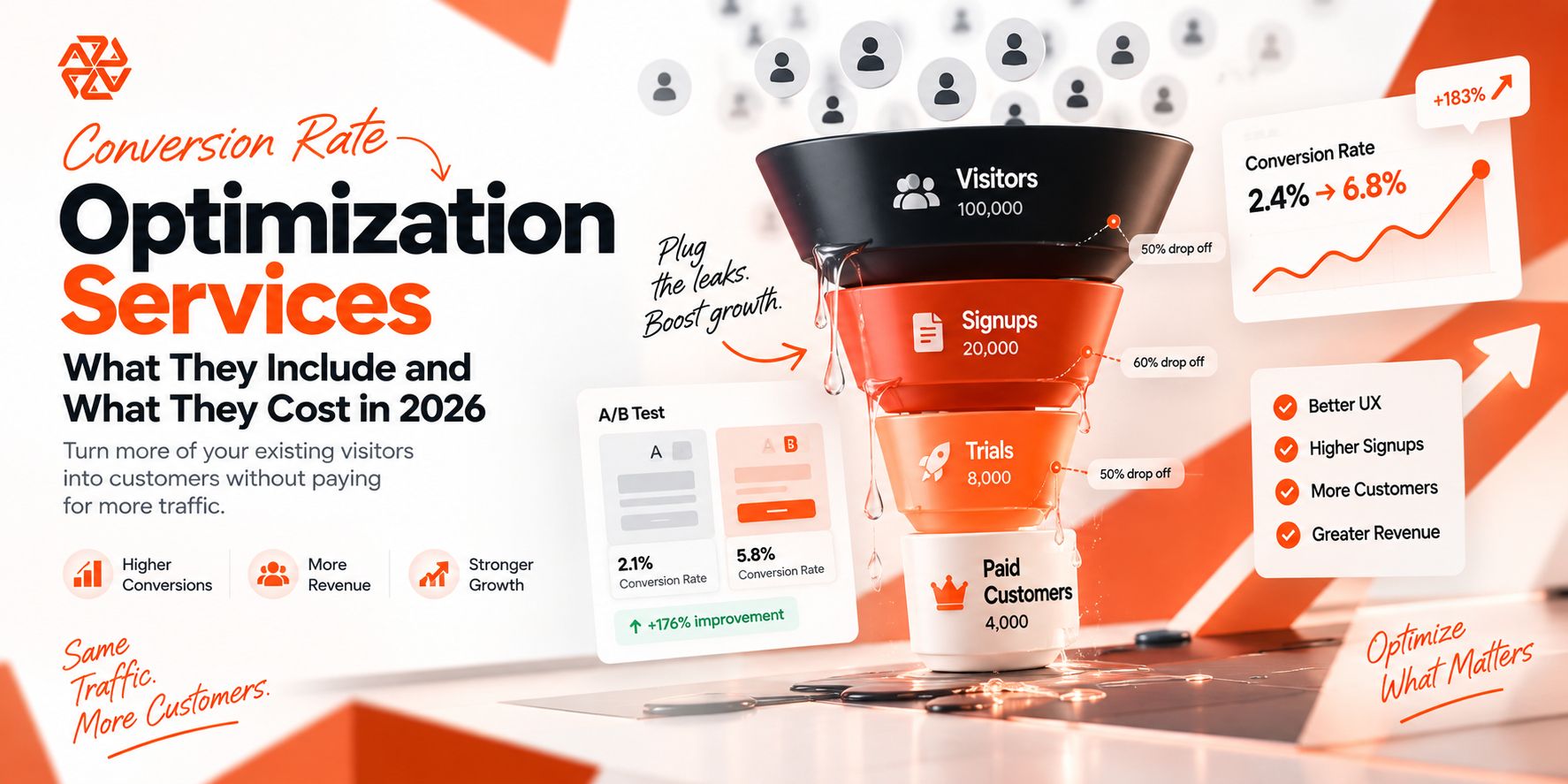
Conversion rate optimization services help you turn more of your existing visitors into customers, without paying for more traffic. That is the entire promise, and it is a good one.
Think about what you spend to fill the top of your funnel. Ads, SEO, content, outreach. All of it costs money. But if those visitors show up, poke around, and leave without acting, you are pouring water into a leaky bucket.
CRO plugs the leaks.
This guide walks you through what conversion rate optimization services actually include, what they cost in 2026, how long they take to pay off, and how to pick a partner who knows the craft. If you run a SaaS product, stick around. Your funnel behaves differently from an online store, and most guides skip right over that.
What Are Conversion Rate Optimization Services?
Conversion rate optimization services are structured programs that increase the share of your visitors who take a desired action. For an online store, that action is a purchase. For a SaaS product, it is usually a free trial, a demo request, or a paid upgrade.
The work goes deeper than most people think. Swapping a button color rarely moves the number on its own. The real wins come from understanding why people hesitate, then testing fixes one at a time.
Here is a sobering benchmark. The average landing page converts just 6.6% of its visitors, according to Unbounce's 2024 Conversion Benchmark Report. For most businesses, traffic is not the problem. What happens after the click is.
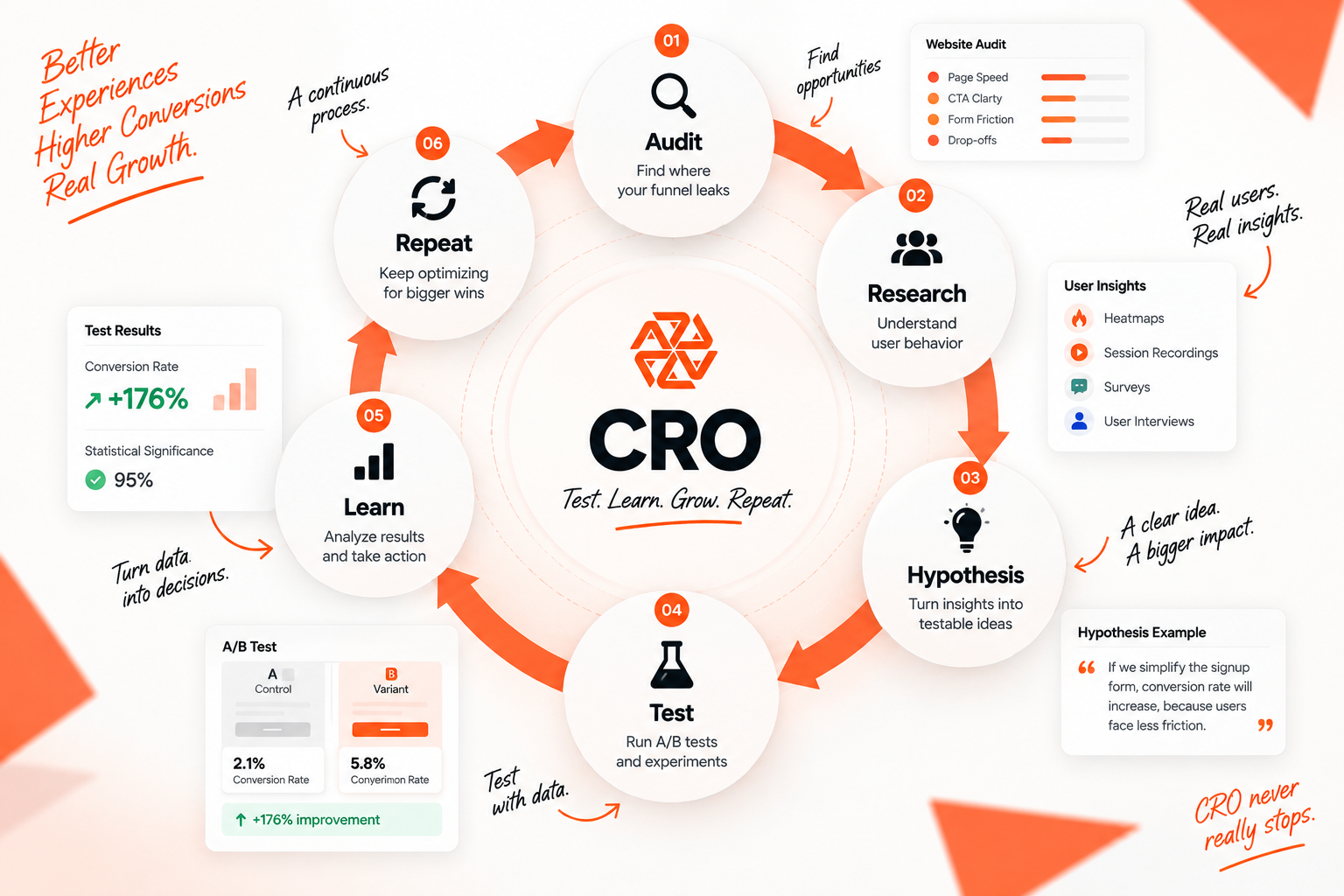
Good CRO runs on a simple loop.
- Audit the funnel to find where it leaks
- Research how real users behave
- Build a hypothesis worth testing
- Run a controlled experiment
- Learn from the result and go again
That loop never really stops. Conversion optimization services are an ongoing practice, not a one-and-done project.
What's Included in CRO Services
Most full-service CRO services cover six core areas. Here is what each one does and why it matters.
Conversion Audit
A conversion audit finds where your funnel leaks before anyone touches a test. The team digs through your analytics, user flows, landing pages, and signup steps to spot friction.
They hunt for problems like these.
- Slow pages that quietly cost you signups
- Calls to action that confuse instead of convince
- Pages with high drop-off rates
- Forms that ask for far too much
User Research and Qualitative Analysis
Numbers tell you what is happening. Research tells you why.
This part usually includes heatmaps, session recordings, on-site surveys, and short user interviews. You are building a picture of the experience from the visitor's side of the screen, not just your dashboard.
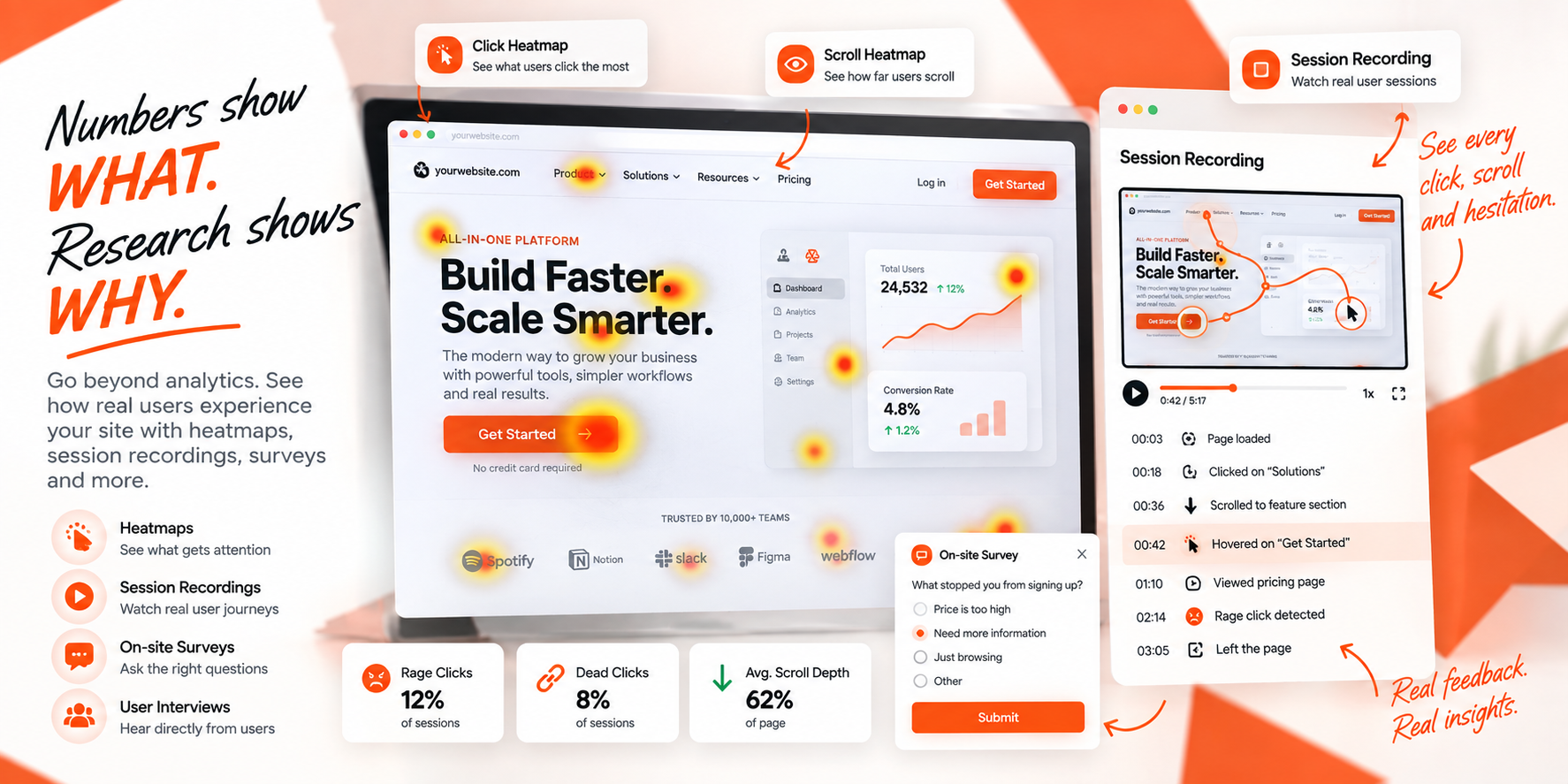
Contentsquare's 2025 Digital Experience Benchmarks found that 40% of site visits show signs of frustration, like rage clicks and dead ends. You can't fix what you can't see.
Hypothesis Development
Every good test starts with a clear hypothesis. It reads like one plain sentence. If you do X, then Y improves, because Z.
Without that structure, you are just running random tests and hoping something sticks. Hoping is not a strategy.
A/B Testing and Experimentation
This is where you prove the idea. A/B testing shows two versions of a page to different visitors, then measures which one wins. Multivariate testing does the same with more variables at once.
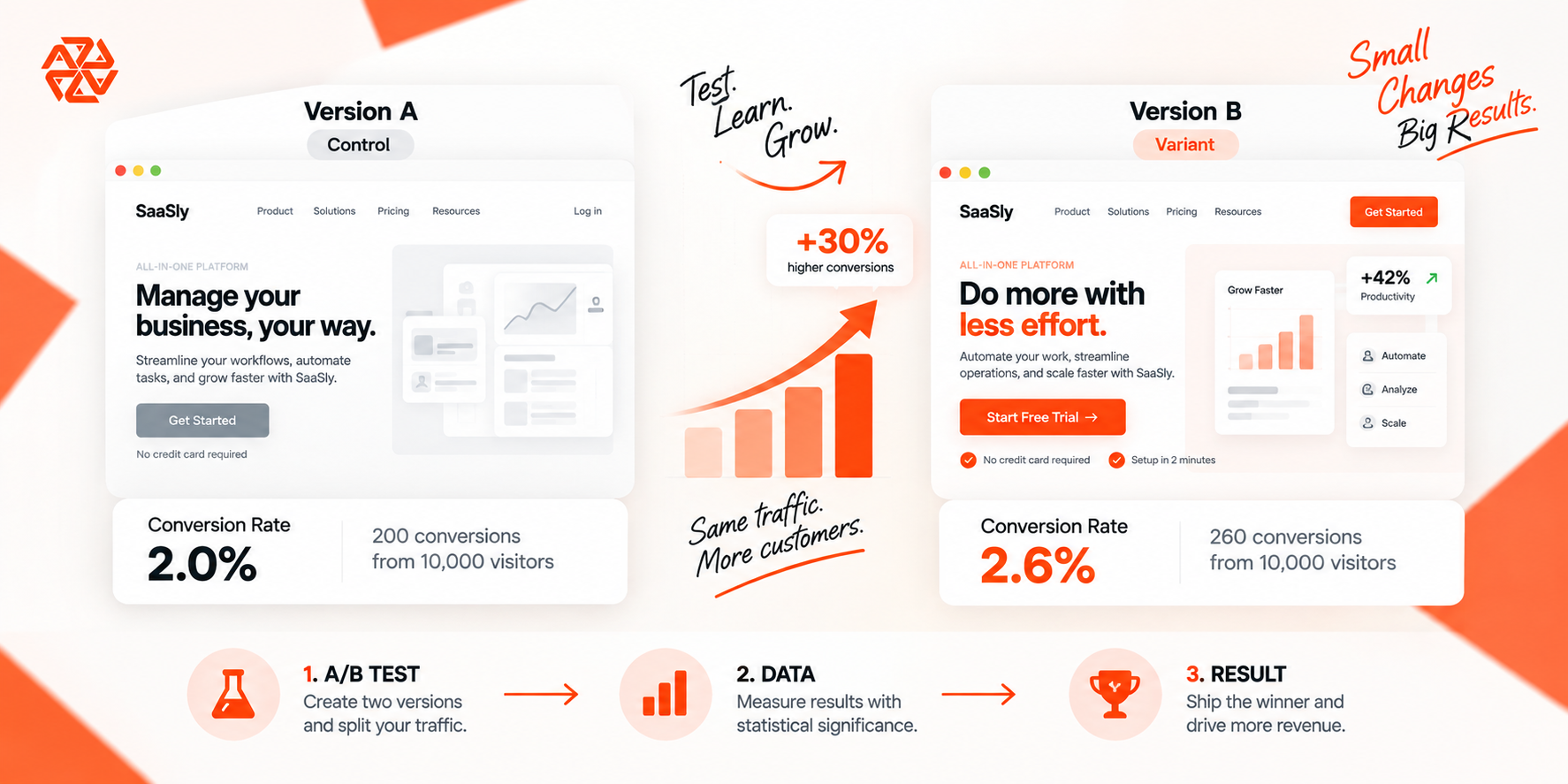
Rigor is everything here. According to Convert, 60% of A/B tests deliver less than a 20% lift. So a reputable team runs each test to statistical significance, documents the result, and saves the learning for next time. Even the losing tests teach you something.
Landing Page Optimization
Landing page optimization means rebuilding the pages that carry your conversions, not just suggesting edits. That might mean rewriting a headline, restructuring a pricing page, or trimming a bloated signup form.
Small changes can pay off big. HubSpot shared an example where FSAstore.com simplified its form fields and saw a 53.8% jump in average revenue per visitor. Same traffic, fewer fields, more money.
User Experience Optimization
User experience optimization removes the friction that makes people bounce. Think faster load times, cleaner navigation, and mobile pages that actually work on a phone.
Confusion is one of the top reasons visitors leave a website. Every extra second of load time and every clumsy step hands them another reason to click away.
CRO Services vs CRO Tools, What You Actually Pay For
A CRO tool runs your tests. CRO services decide what to test and why. You are paying for judgment, not software.
Tools like Hotjar, VWO, and Optimizely are available to anyone with a budget. They collect data and split traffic. But they won't tell you which hypothesis is worth chasing or how to read a messy, inconclusive result.
That thinking is the part you hire conversion optimization services for. The software is cheap. The expertise is not.
The Main Types of CRO Service Models
Conversion rate optimization services come in four main models. Pick the one that fits your stage and budget.
A one-time audit is the usual entry point. A testing retainer is the most common model for growing businesses. Full program management is the high-touch option for sites with real traffic and a mandate to grow fast. The right conversion rate optimization services will help you choose the model that fits, not just upsell the biggest one.
How Much Do Conversion Rate Optimization Services Cost?
Most conversion rate optimization services cost between $1,000 for a one-time audit and $30,000 or more per month for full program management. Where you land depends on your traffic, your goals, and how much you hand off.
Here is the rough market map.
- Freelance CRO consultants charge $75 to $200 per hour, or $1,000 to $5,000 per month on retainer
- Mid-tier agencies run $3,000 to $8,000 per month
- Enterprise agencies run $10,000 to $30,000 or more per month
- CRO software sits at $200 to $2,000 per month, depending on your traffic
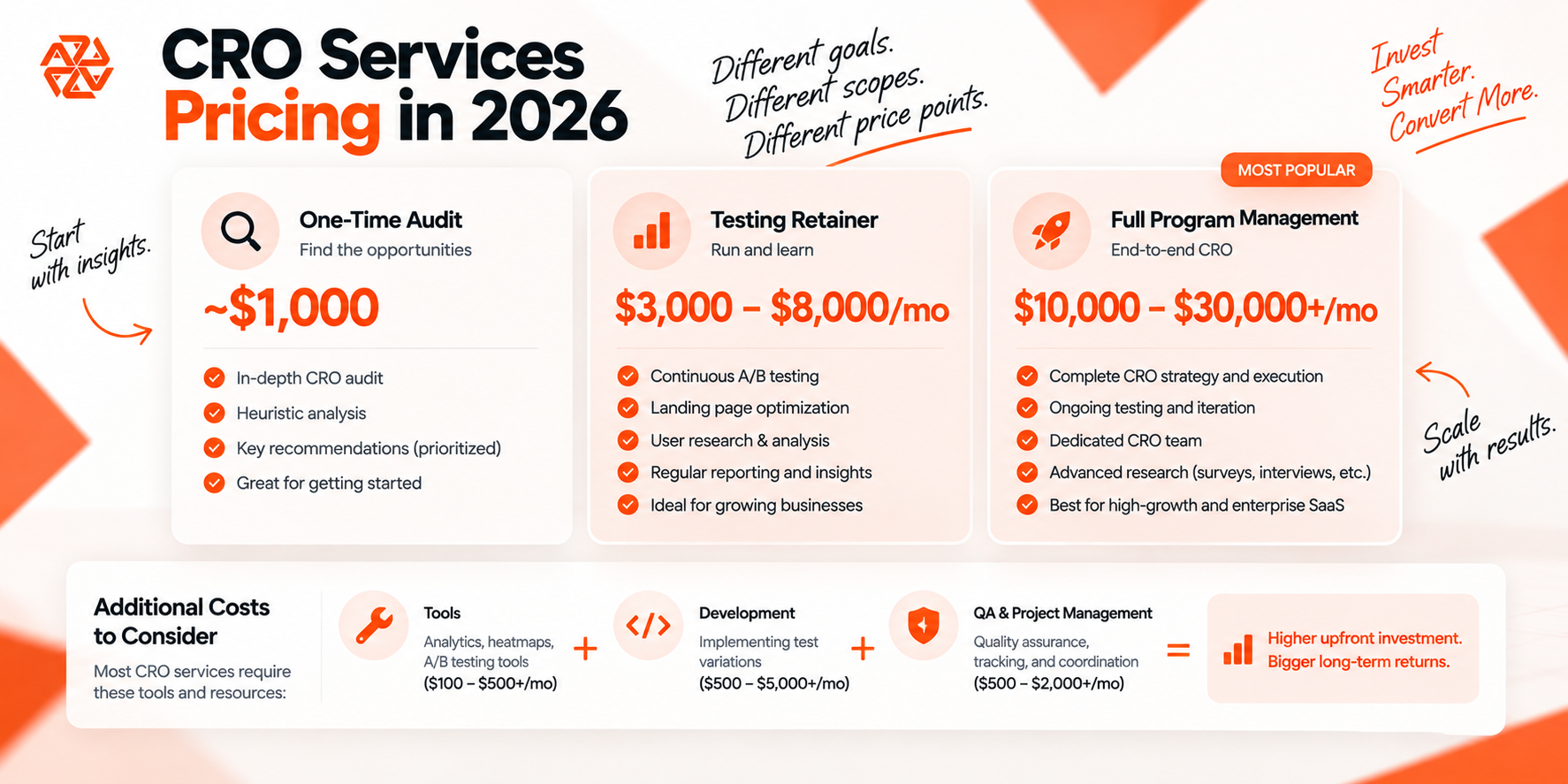
There is a catch most people miss. The retainer is not the full bill. Testing tools and developer hours ride on top, often adding 30 to 50%. A $5,000 retainer can realistically cost you $7,000 to $8,000 once everything is counted.
A Simple Way to Size the ROI
Judge the price against the revenue it can unlock, not the monthly fee on its own.
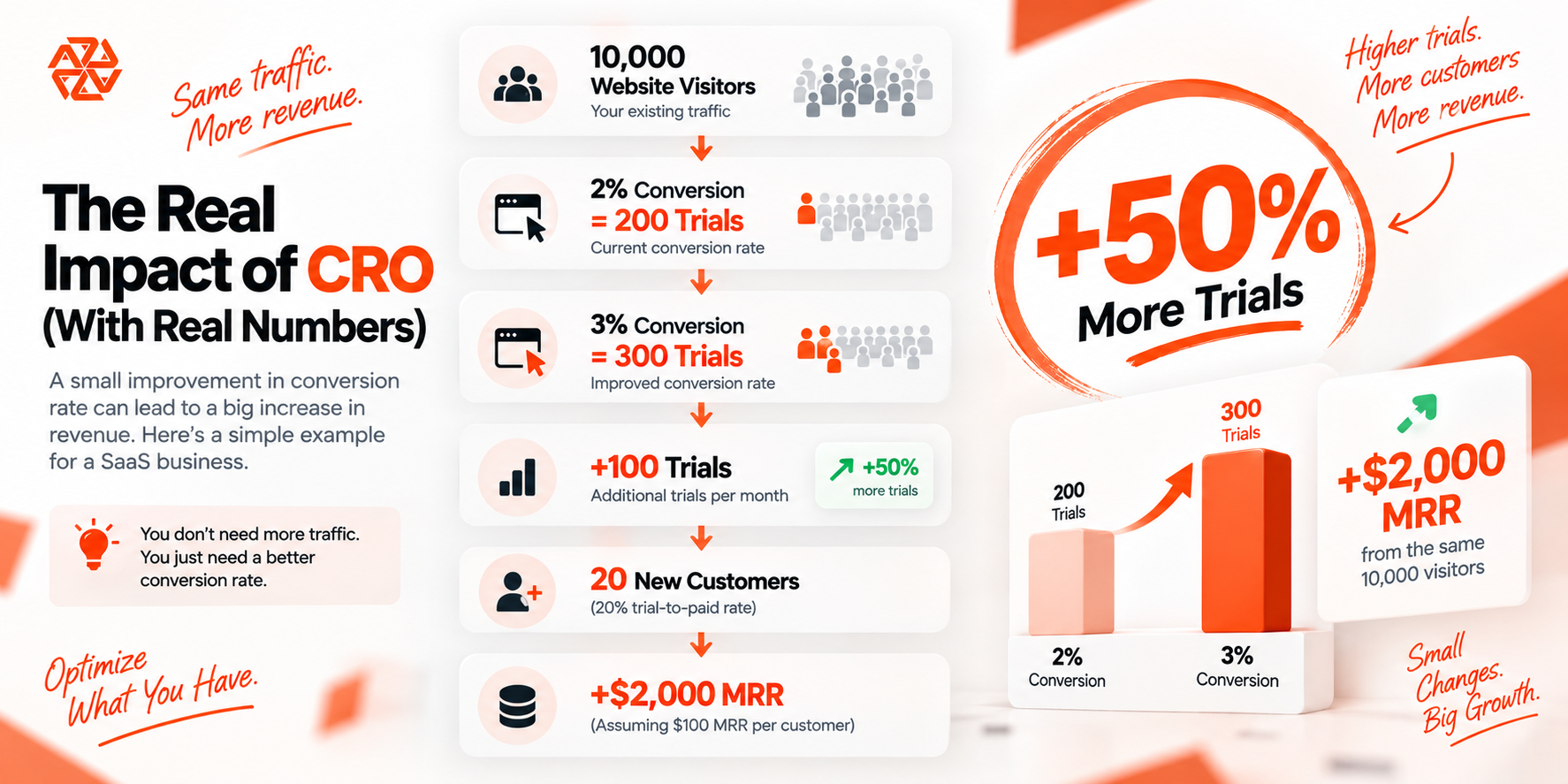
Here is a quick SaaS example. Say your pricing page gets 10,000 visitors a month and converts 2% into free trials. That is 200 trials. Lift it to 3% and you get 300 trials, a 50% jump, from the exact same traffic.
Now carry that through. If 20% of trials turn into paid plans at $100 a month, those extra 100 trials become 20 new customers and $2,000 in fresh recurring revenue. Every single month. Suddenly a $5,000 retainer looks less like a cost and more like a lever.
How a CRO Engagement Runs, and When to Expect Results
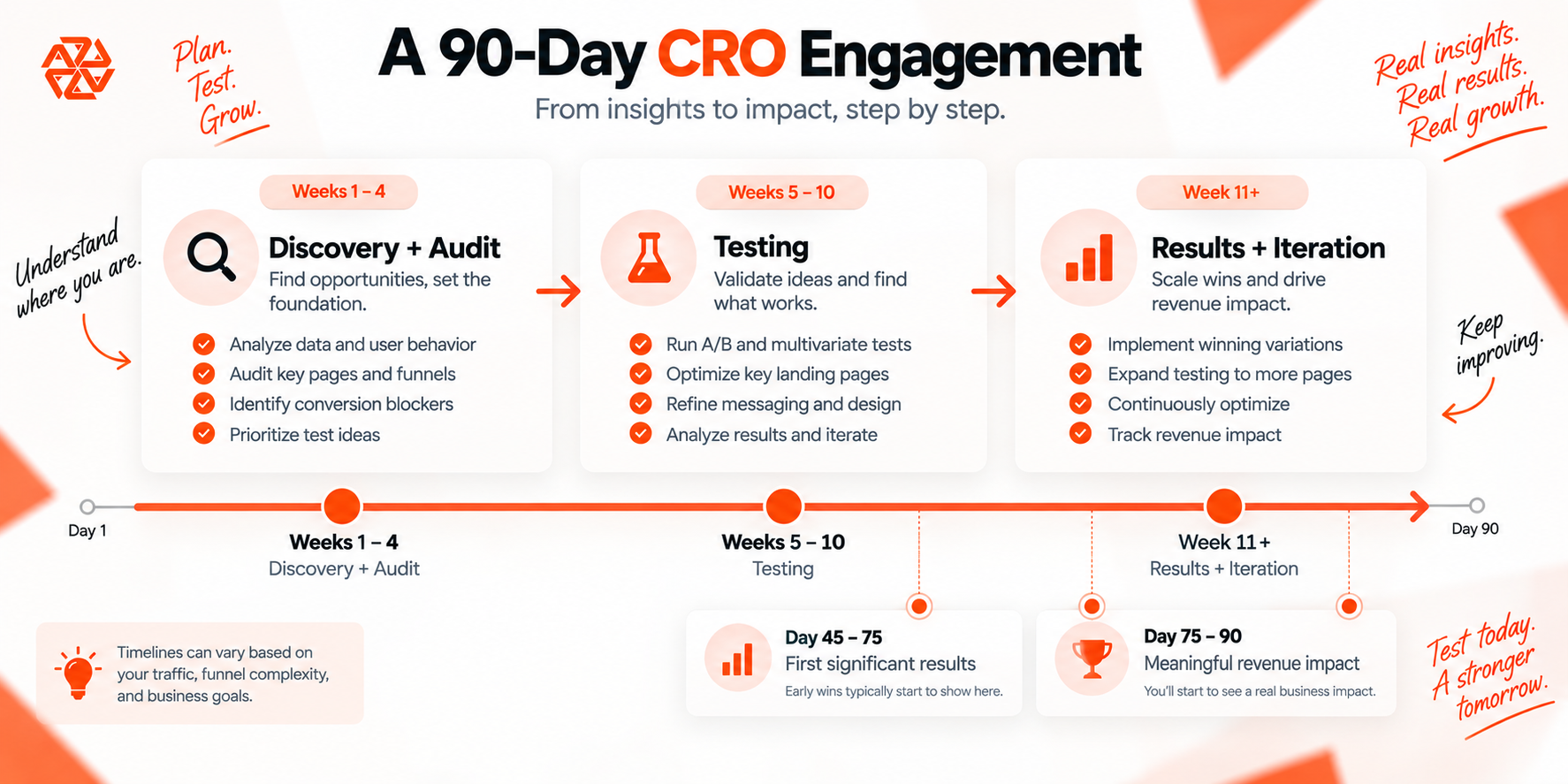
Good conversion rate optimization services follow a clear timeline. A well-run CRO engagement moves through three phases over roughly 90 days. Research first, testing next, then results and iteration.
Phase 1, Discovery and Audit (Weeks 1 to 4)
The team gathers quantitative data from your analytics and qualitative data from recordings, heatmaps, and surveys. They map your funnel, find the highest-value drop-off points, and build a prioritized test backlog.
Rushing this phase is the single most common reason CRO programs underperform. The research sets the direction for everything that follows.
Phase 2, Testing (Weeks 5 to 10)
The first tests go live. Each one needs a variant design, QA across devices and browsers, and enough traffic to reach statistical significance. This is where discipline beats speed.
Phase 3, Results and Iteration (Week 11 and Beyond)
First statistically significant results usually appear between day 45 and day 75. A realistic benchmark for a strong program is a 5 to 15% relative lift on your optimized pages within 90 days. Then you take what you learned and run the next round.
CRO for SaaS, Why Your Funnel Is Different
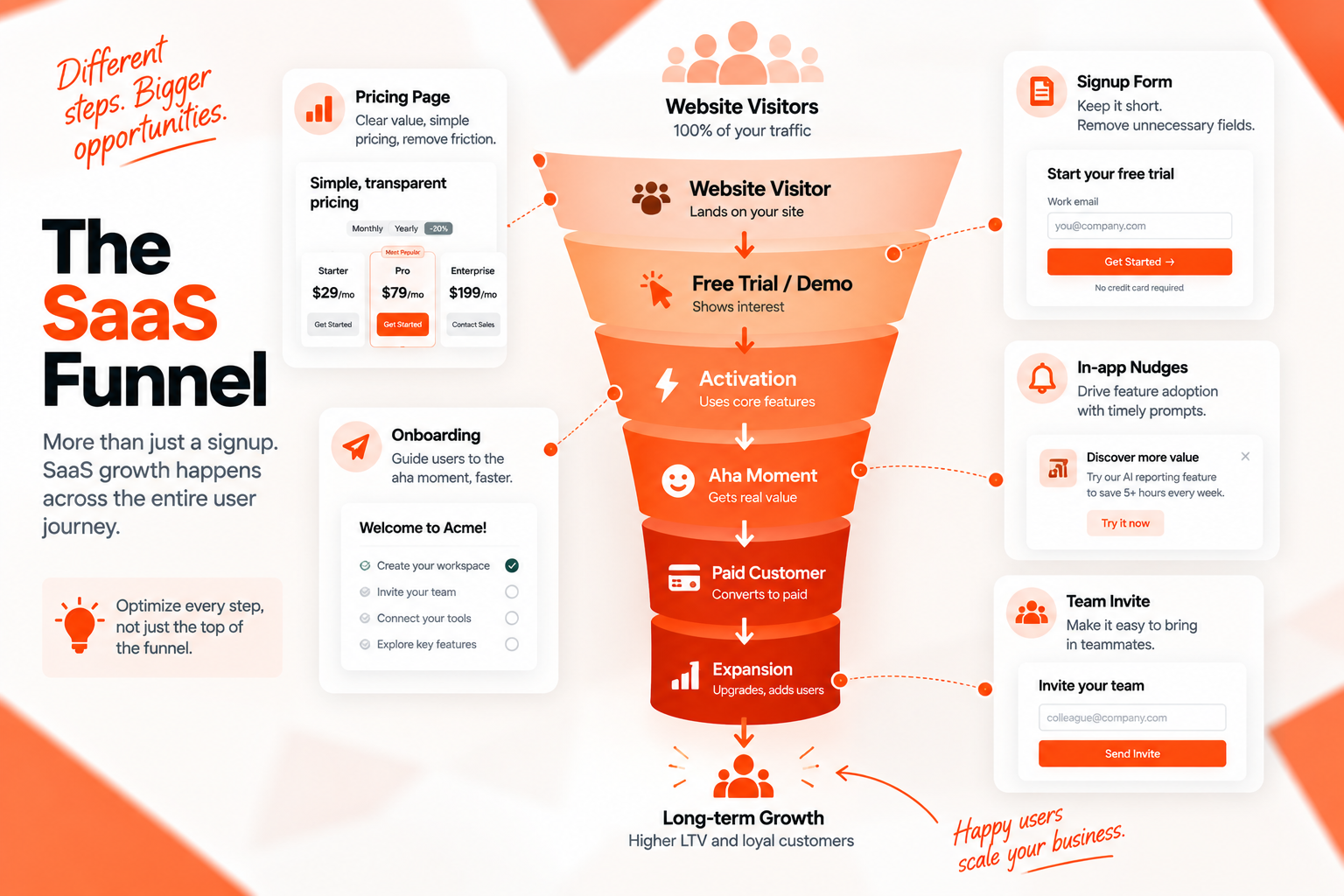
SaaS CRO is not ecommerce CRO. Your conversions are trials, demos, and upgrades, not cart checkouts. Your traffic is often lower too, and that changes how you test.
Most CRO guides assume you sell physical products with a checkout. If you sell software, the levers sit in different places.
Here is where SaaS CRO usually focuses.
- Free trial and demo signups. You cut form friction and make the value obvious before anyone commits.
- Pricing page tests. You test how you present plans, anchor your tiers, and toggle monthly versus annual billing.
- Trial-to-paid conversion. This is driven by onboarding, activation moments, and well-timed in-app nudges.
- Product-led self-serve funnels. The whole goal is getting users to their aha moment fast.
- The low-traffic reality. Fewer visitors means tests take longer to reach significance.
That last point matters more than people admit. The average B2B SaaS company converts only about 2.1% of organic visitors into leads. When your traffic is modest, you focus tests on your highest-impact pages and let them run longer.
When You Should Not Invest in CRO Yet
If your test pages get fewer than 5,000 monthly sessions, hold off on a full testing retainer. You simply don't have enough traffic to trust the results yet.
Conversion rate optimization services can pay off in a big way, but timing matters just as much as the work itself.
Low traffic means tests take forever to reach significance, and you end up making decisions on noise. That is worse than making no change at all.
Here is what to do instead.
- Start with a one-time audit to surface the obvious problems
- Fix the basics first, like slow pages, broken flows, and unclear calls to action
- Grow your traffic until your key pages can support real testing
A good partner will tell you this honestly. If an agency pushes a full retainer on a site with barely any traffic, that tells you something about them.
How to Choose the Right CRO Partner
There are plenty of CRO services out there, and the gap between the best and the rest is huge. The best partner researches before it tests, documents everything, and shows you real results. Here is how to spot one.
Look for a Research-First Process
Ask them directly how they decide what to test. If the answer is gut feel or best practices, keep looking. The strongest teams are obsessive about understanding your users before they change a thing.
Ask to See Documented Results, Wins and Losses
A good team learns as much from a failed test as a winning one, and they write it all down. If they can't show you a clear history of experiments with outcomes attached, treat that as a red flag.
Check Their Testing Rigor
Ask how they measure statistical significance, how long they run a test before calling it, and how they handle traffic segmentation. Sloppy testing produces sloppy results, and a lift that is not significant is not really a lift.
Prioritize Relevant Experience
An agency that lives in ecommerce checkout flows may not understand your SaaS trial funnel. The principles carry over, but context matters. Look for case studies close to your own model.
Red Flags to Walk Away From
Some warning signs are hard to miss once you know them.
- Guaranteed conversion lifts before any research is done
- No documented testing methodology
- Vague reports with no link to revenue
- No mention of sample size or statistical significance
Questions to Ask Before You Sign
Before you commit to any retainer, get clear answers to these seven questions.
- What does your research process look like before the first test goes live?
- How many tests do you run each month, and what is your win rate?
- Who specifically will work on our account, and what is their background?
- How do you handle losing or inconclusive tests?
- Can you show a case study from our industry or business model?
- What tools do you use, and are they included in your fee?
- How do you connect test results to revenue in your reporting?
In-House vs Agency vs Freelancer
Not all CRO services are delivered the same way. Your best option comes down to traffic, budget, and how much time your team really has.
- Freelancer. Flexible and affordable, and works well when you have people in-house to run the tests.
- Agency. A full team and a proven process, which suits most growing SaaS companies.
- In-house specialist. Speed and deep context, but hiring and training one is a real investment.
Most growing businesses get the best return from an agency retainer, at least until their internal team is ready to own the program.
The Role of AI in CRO in 2026
AI is speeding up conversion rate optimization services, not replacing the strategy behind them.
Here is where AI is already earning its keep.
- Autonomous testing platforms. They cut variant build time from hours down to minutes.
- AI-assisted research. It surfaces patterns in session data faster than a human can.
- Personalization engines. They tailor pages to different segments in real time.
- AI Overviews in search. They are shifting which visitors land on your pages, so your messaging has to match a higher-intent reader.
Still, the judgment stays human. AI can run a test at scale. It can't decide what is worth testing or what a surprising result means for your business. The strategy is still yours.
Frequently Asked Questions
How long does it take to see results from CRO services?
First statistically significant results usually show up between day 45 and day 75 of an engagement. Meaningful revenue impact tends to appear around day 75 to 90. CRO compounds, so results build as you run more tests.
How much do conversion rate optimization services cost?
Costs range from about $1,000 for a one-time audit to $30,000 or more per month for full program management. Testing retainers usually run $3,000 to $8,000 per month, plus extra for tools and developer time.
How much traffic do I need before CRO testing is worth it?
As a rule of thumb, each test page needs at least 5,000 monthly sessions to produce numbers you can trust. Below that, a one-time audit and a few foundational fixes will serve you better than a full testing retainer.
What is a realistic conversion rate lift to expect?
A 5 to 15% relative lift on optimized pages within 90 days is a fair benchmark for a well-run program. Your actual results depend on your starting conversion rate, your traffic, and the quality of the testing.
Do CRO services work for SaaS, or only ecommerce?
They work for both, but the focus shifts. SaaS CRO centers on trials, demos, pricing pages, and trial-to-paid conversion, while ecommerce CRO centers on product pages and checkout. Look for a partner with SaaS experience if you sell software.
Can I run CRO in-house instead of hiring a service?
Yes, if you have the traffic, the tools, and someone who understands statistics and test design. Many teams start with an agency to build the process, then bring it in-house once they have the skills and the cadence in place.
The Bottom Line
Conversion rate optimization services are one of the highest-return investments you can make, because they pull more revenue from traffic you already paid for. Instead of buying more clicks, you make the clicks you already have count.
The playbook is not complicated. Research first. Test with discipline. Document every result. And choose a partner with real experience in your model, especially if you run SaaS.
Do that, and you stop leaving conversions on the table. That is the whole point.