How to Get Cited by AI: A 2026 Guide for ChatGPT, Perplexity, and Google AI Overviews
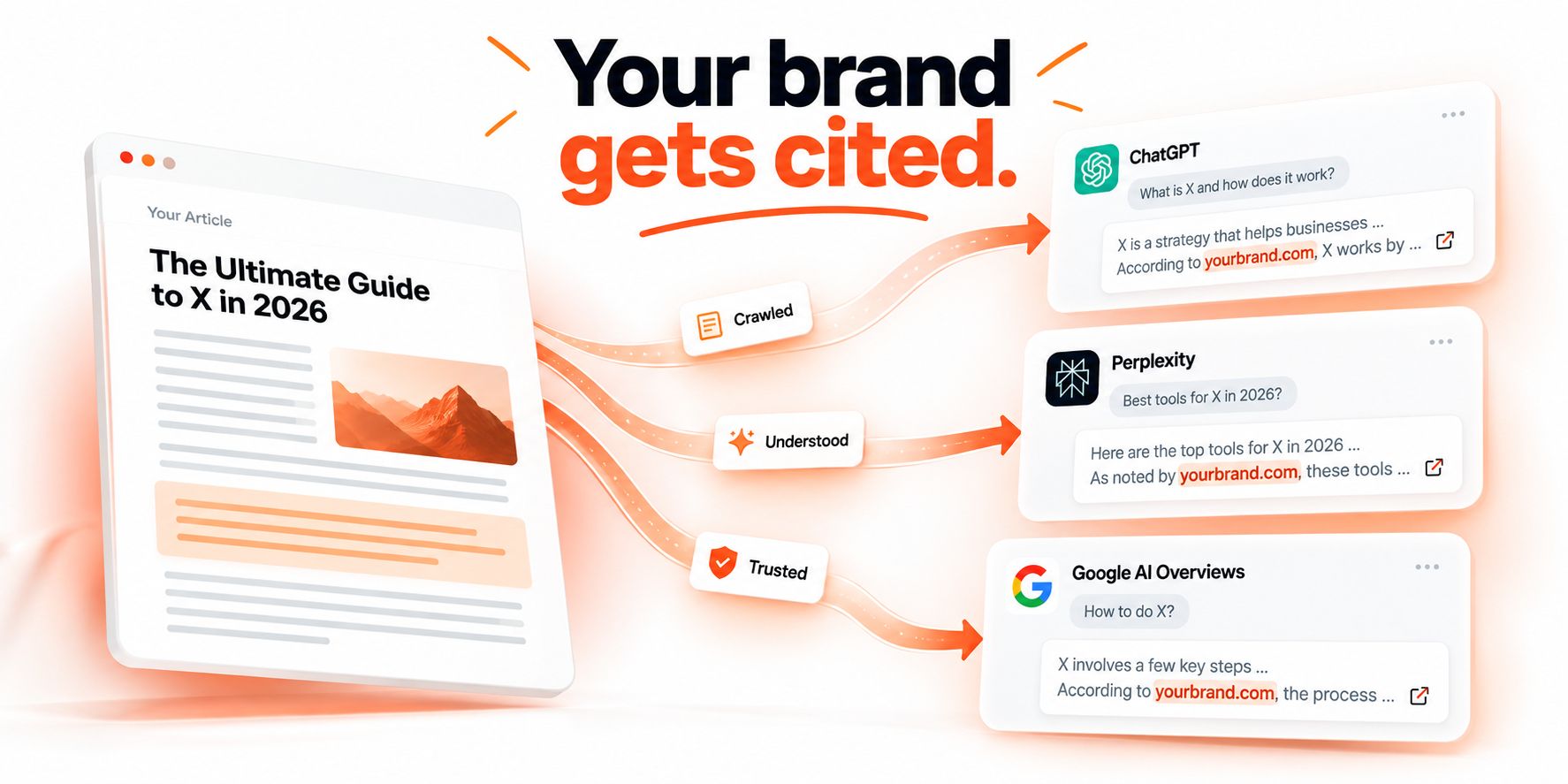
Search changed while you were busy ranking. People now ask ChatGPT, Perplexity, or Google a question and get a finished answer, with a few sources credited inside it. If your brand is not one of those sources, you are invisible on that query.
So the real question for 2026 is simple. How do you get cited by AI?
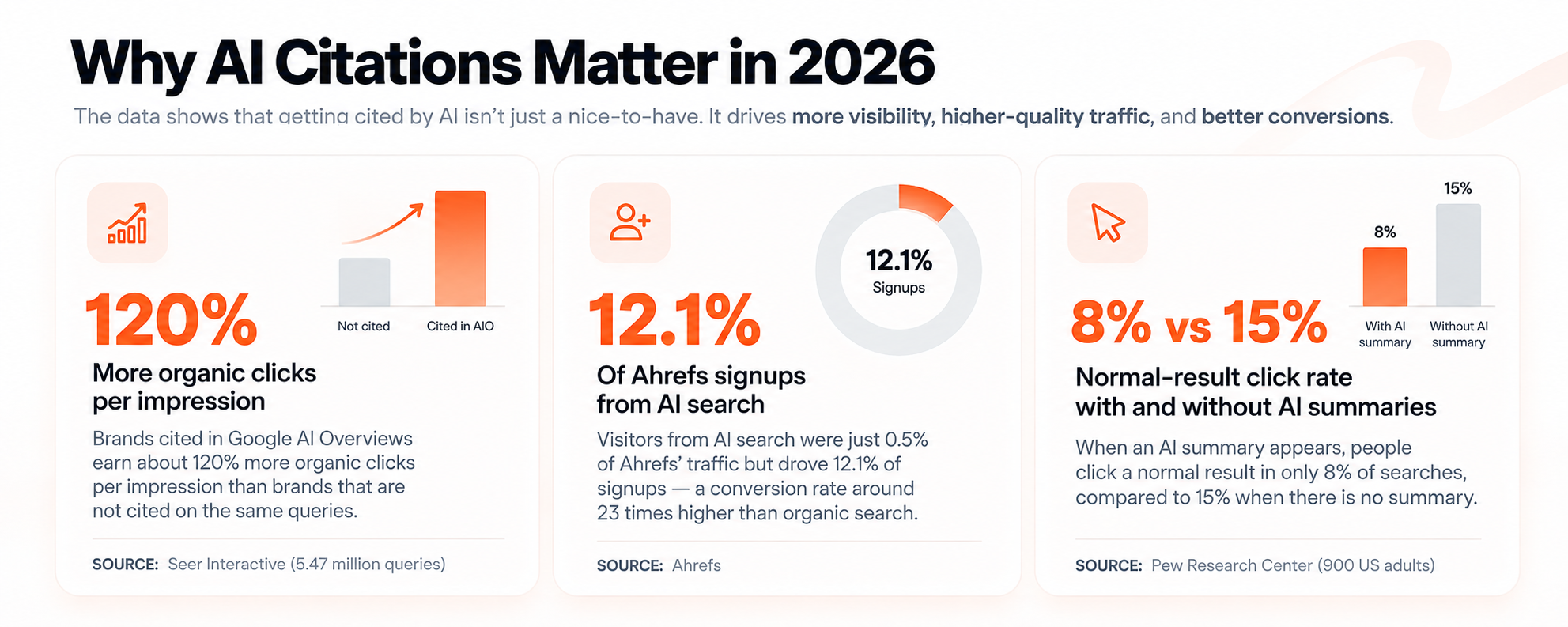
Here is why it is worth the effort. Seer Interactive analyzed 5.47 million queries and found that brands cited in Google AI Overviews earn about 120% more organic clicks per impression than brands that are not cited on the same queries. Getting named in the answer is the new front page.
This guide shows you how to get cited by AI, step by step. You will learn the tactics that work across every engine, the moves that are specific to each one, and the things that quietly waste your time.
What Does It Mean to Get Cited by AI?
Getting cited by AI means an answer engine uses your content as a source and credits you in its response. Think of it as a citation inside someone else's answer, not a link in a long list.
It runs on a practice called answer engine optimization, or AEO. AEO is the work of structuring your content so AI systems can find it, understand it, trust it, and quote it.
You will also hear the term GEO, short for generative engine optimization. Treat GEO as the wider system and AEO as the content layer inside it. Either way, the goal is the same. You want the answer engine to name you. That is what it means to get cited by AI.
Why It Pays to Get Cited by AI in 2026
The channel is small today. It also converts better than almost anything else you run.
Look at the numbers.
- Higher conversions. Ahrefs found that visitors from AI search were just 0.5% of their traffic but drove 12.1% of signups. That is a conversion rate around 23 times higher than organic search.
- Fewer clicks to go around. Pew Research Center tracked 900 US adults and found that when an AI summary appears, people click a normal result in only 8% of searches, against 15% when there is no summary.
Read those together, and the story is clear. Fewer people click. The ones who do are worth more. And the only way to stay visible on an AI answer is to be the source it quotes.
How AI Engines Decide What to Cite
Before you optimize anything, understand the path your page takes to become a citation. It has four steps.
- Crawl. An AI bot has to reach and read your page.
- Retrieve. The engine pulls your page into the set it considers for a query.
- Extract. It lifts a clean passage that answers the question.
- Trust. It decides your passage is credible enough to show and credit.
Miss any step, and you do not get cited. A blocked page never gets crawled. A buried answer never gets extracted. A thin, sourceless page never earns trust. Clear all four, and you get cited by AI. Every tactic below maps to one of these four steps.
How to Get Cited by AI: The Core Playbook
These moves work across ChatGPT, Perplexity, Google AI Overviews, and the rest. Master them first, then tune for each engine. This is how to get cited by AI on any platform.
Target the Queries That Trigger AI Answers
Not every query gets an AI answer, so not every page is worth optimizing first.
Seer Interactive found that comparison queries trigger an AI Overview about 95% of the time, and question-format queries about 86%. Navigational and brand-name queries rarely do.
So spend your first hours on comparison pages, how-to guides, and question-shaped content. That is where you get cited by AI most often.
Structure Your Page for Extraction
Structure is how you get cited by AI once a page is reachable.
Lead With the Answer
Put a direct, 40 to 60 word answer near the top of the page. State the definition or the core claim before any backstory.
AI engines pull from the top of a page far more than the bottom. If your answer sits under three paragraphs of throat-clearing, it may never get lifted.
Example. Instead of opening with "link building has changed a lot over the years," open with "the best link building tool for SaaS is X, because it does Y." Then explain.
Write Question-Based Headings
Phrase your H2s and H3s the way people ask the question. "How do you get cited by ChatGPT?" beats "ChatGPT citation tips."
Engines match the question to your heading, then extract the passage beneath it. Aim for most of your headings to read like real questions.
Break Content Into Self-Contained Passages
Each section should answer its own heading without leaning on the ones before it. AI engines pull passages, not whole pages.
Keep the core answer under each heading to about 40 to 80 words. Add the detail after.
Add an FAQ Section
A clean FAQ section is one of the strongest signals you can add. It arrives pre-broken into question and answer pairs, which is exactly how engines retrieve answers.
Use four to six real questions. Mark them up with FAQPage schema, and make the schema text match the visible question word for word.
Build Trust and Authority
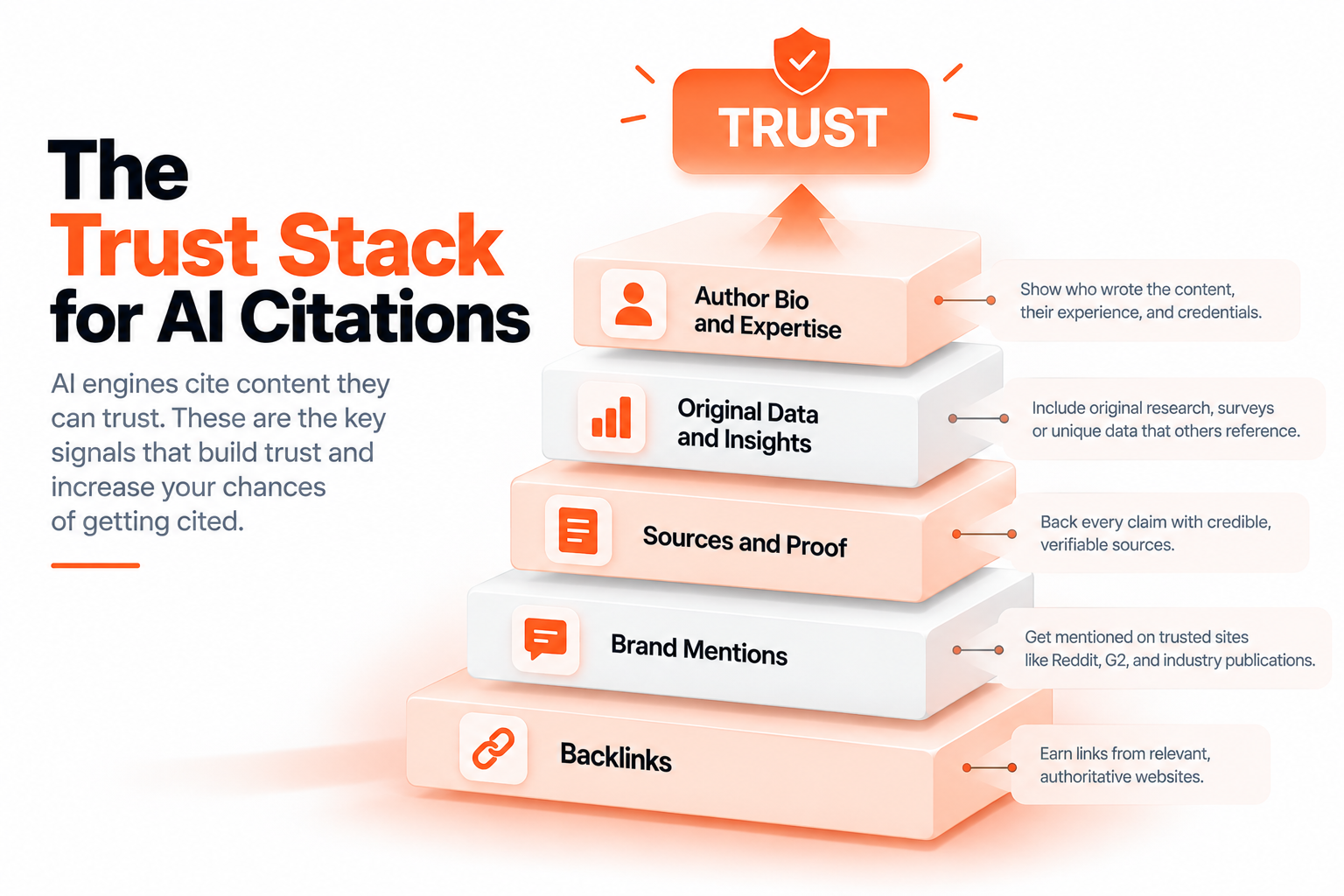
Trust is the other half of how to get cited by AI.
Back Every Claim With Proof
Sourced content gets cited more than opinion. The Princeton GEO study tested nine tactics across thousands of queries and found that citing sources, adding statistics, and quoting experts lifted visibility in AI answers by up to 40%. Keyword stuffing dragged it down.
- Add real numbers. Named stats with a source beat "studies show."
- Quote named experts. A credited quote gives the engine something attributable.
- Link your sources. Named, linked references were the strongest single signal in the Princeton data.
Add Schema Markup
Schema tells engines what your content is. Add FAQPage, Article, and HowTo schema where they fit.
It is not a magic lever, but missing schema on a well-built FAQ is leaving an easy signal on the table. Validate it before you publish.
Build Off-Page Authority and Brand Mentions
Structure gets you extractable. Authority gets you chosen. Engines learn who to trust by watching your brand get discussed around the web. On Reddit. On review sites like G2 and Capterra. In roundups and industry blogs.
- Earn brand mentions where your buyers already talk.
- Build backlinks that lift the organic rankings AI leans on.
- Publish original data so other sites cite you, which teaches engines you are a primary source.
This is the slow, compounding part. It is also the hardest to fake, which is exactly why it works.
Show Author, Freshness, and Original Data
Give every page a named author with a real bio. Show a visible last-updated date. Refresh your priority pages on a schedule.
AI-cited content skews recent, so a page you updated last month tends to beat one you left untouched for two years.
Focus on the Formats That Get Cited Most
Some formats earn citations more than others. Lean into these.
- Comparison pages, like X vs Y
- How-to guides
- FAQ pages
- Glossary and definition pages
- Original research and data
They map to how people ask AI questions, so you get cited by AI more often.
How to Get Cited by ChatGPT, Perplexity, and Google AI Overviews
The core playbook gets you most of the way. But each engine has its own quirks. Here is how to get cited by each one.
How to Get Cited by ChatGPT
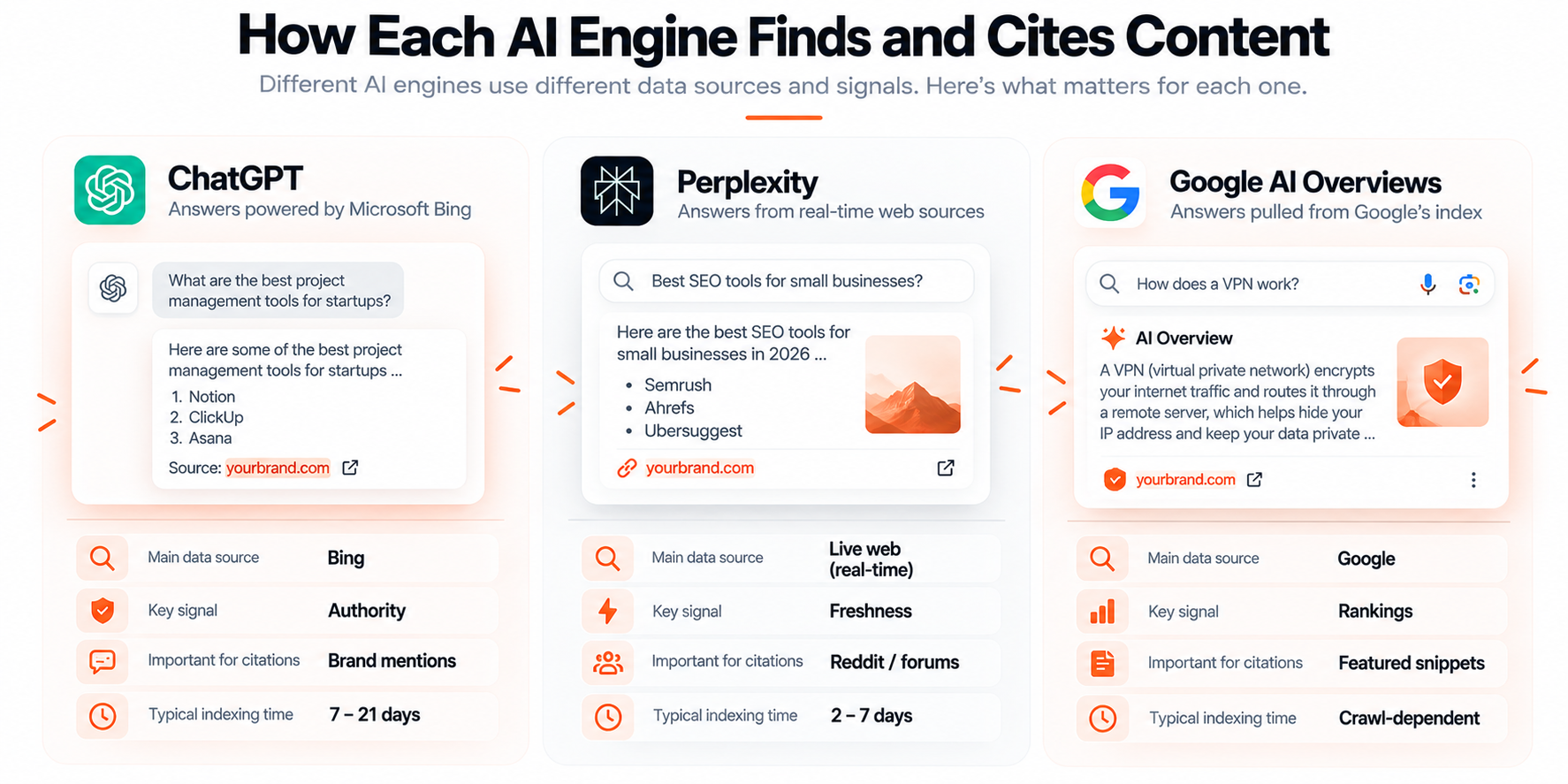
To get cited by ChatGPT, know where it looks. ChatGPT leans on Bing's index for web results. So your Bing ranking matters more than you think, and ChatGPT shows about 87% citation overlap with Bing's top 10.
- Rank in Bing, not just Google.
- Build brand mentions and a clear web presence, since ChatGPT weights established authority.
- Be patient. New pages tend to show up in ChatGPT within about 7 to 21 days.
How to Get Cited by Perplexity
To get cited by Perplexity, feed its taste for fresh, community content. Perplexity runs a live web search for most answers, so freshness wins. It also leans heavily on community sources. Nearly half of its citations, around 46.7%, come from Reddit.
- Keep content fresh and add clear, recent dates.
- Show up on Reddit, Quora, and forums where your topic gets discussed.
- Source everything, since Perplexity favors well-cited, factual pages.
Perplexity is also the fastest to react. New content can get cited in about 2 to 7 days.
How to Get Cited in Google AI Overviews
Google AI Overviews pull mostly from pages that already rank. Ahrefs found that 76% of AI Overview citations come from pages in the top 10 organic results.
- Win strong organic rankings first.
- Own featured snippets, which often feed the Overview.
- Keep solid SEO fundamentals, since there is no separate trick beyond ranking and clear structure.
What Does Not Work
Some popular AEO advice does nothing. Skip these.
- llms.txt files. Several studies found no link between having one and getting cited more. Make one for clarity if you want, but do not expect a lift.
- Padding word count. Longer is not better. A short page with a clean answer beats a long page that buries it.
- Mass AI content. Bulk, unedited AI pages lack the sources and expertise engines look for, so they get downweighted.
- Keyword stuffing. The Princeton study measured it as a net negative. Write for meaning, not density.
How to Measure If It Is Working
Track citations, not just rankings. Watch three numbers.
- Citation rate. How often you get named for your target questions.
- Share of voice. How often you are cited versus competitors on the same queries.
- AI referral traffic. Segment visits from ChatGPT, Perplexity, and Gemini in GA4 so you can see conversions.
Tools like Ahrefs Brand Radar, Peec AI, and Otterly track citations for you. A manual quarterly check across 15 to 20 priority queries also works.
Frequently Asked Questions
What is the difference between AEO and SEO?
SEO gets your page ranked so people click it. AEO gets your content cited when AI writes an answer. SEO chases the click; AEO chases the citation. They share the same foundation, so you need both.
How long does it take to get cited by AI?
It depends on the engine. Perplexity can cite fresh content in about 2 to 7 days. ChatGPT usually takes 7 to 21 days. Google AI Overviews follow Google's crawl schedule. Building the authority to win competitive citations takes months.
Do backlinks still matter for getting cited by AI?
Yes. Backlinks lift the organic rankings that AI Overviews pull from, and they carry brand mentions that teach engines to trust you. They help you get cited by AI, not just rank.
Do I need schema markup to get cited?
It helps, but it is not required. Schema makes your content easier for engines to parse, especially FAQ and Article schema. Get your answer structure right first, then add schema on top.
How do I get cited by ChatGPT specifically?
Rank well on Bing, since ChatGPT pulls heavily from Bing's index. Build brand mentions and a clear web presence. Then give it a week or two, as new pages usually appear in ChatGPT within 7 to 21 days.
How do I know if I am getting cited?
Run your key questions through each engine and record whether you are named. Track your citation rate and share of voice over time. Segment AI referral traffic in GA4 to see what those visits are worth.
The Bottom Line on How to Get Cited by AI
Learning how to get cited by AI comes down to three moves. Get found by the crawlers. Structure your page so the answer is easy to lift. Earn the trust that makes an engine pick you over the next page.
Start with the core playbook, then tune for each engine. Lead with the answer, ask real questions in your headings, back every claim with a source, and build the brand mentions that prove you are worth quoting.
Do that, and you stop watching AI answer questions with someone else's name attached. You become the source.
That is the work Anchorial does. We build the links, brand mentions, and AEO foundation that get you cited across ChatGPT, Perplexity, and Google AI Overviews. If you want to be the answer, let's talk.