Niche edits are backlinks added to articles that already exist and already rank. Instead of publishing something new, you get your link slotted into a page Google has trusted for years.
That speed is the whole appeal. It is also why the tactic gets abused more than just about anything else in link building.
Done well, a single niche edit lands your link on a relevant, trafficked page and starts nudging your rankings inside a few weeks. Done badly? It buries you in a network of junk sites and quietly paints a target on your back.
So the entire game is telling those two apart. This guide covers what niche edits are, how they work, whether they are actually safe, what a good one looks like up close, what you should pay in 2026, and how to buy them safely without getting burned. First, what they actually are.
What Are Niche Edits?
Niche edits are links inserted into existing, already-published content on someone else’s website. You will also see them called link insertions, contextual links, or curated links. Same tactic, different labels.
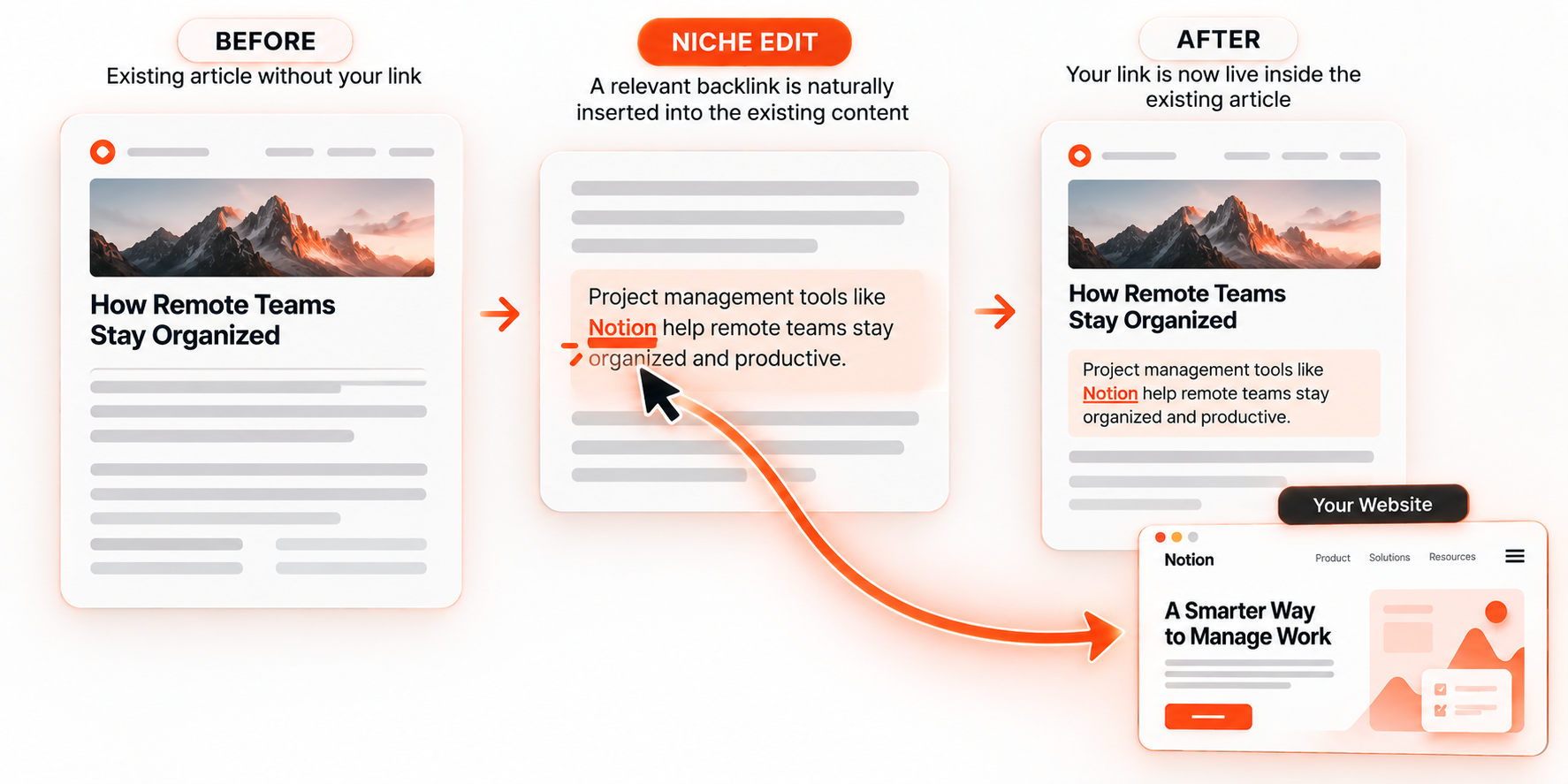
Picture it like this. Somewhere out there sits a blog post from 2022 that still ranks well and pulls steady traffic month after month. The edit adds your link inside that post, in a spot where it genuinely fits the topic. You skip the writing entirely and inherit the page’s history instead.
And that history is the whole point. The page is already indexed. It may already have backlinks of its own. Your link steps straight into all of it rather than starting from a cold, blank slate.
How Do Niche Edits Work?
The process is simpler than most link building. It really comes down to four moves.
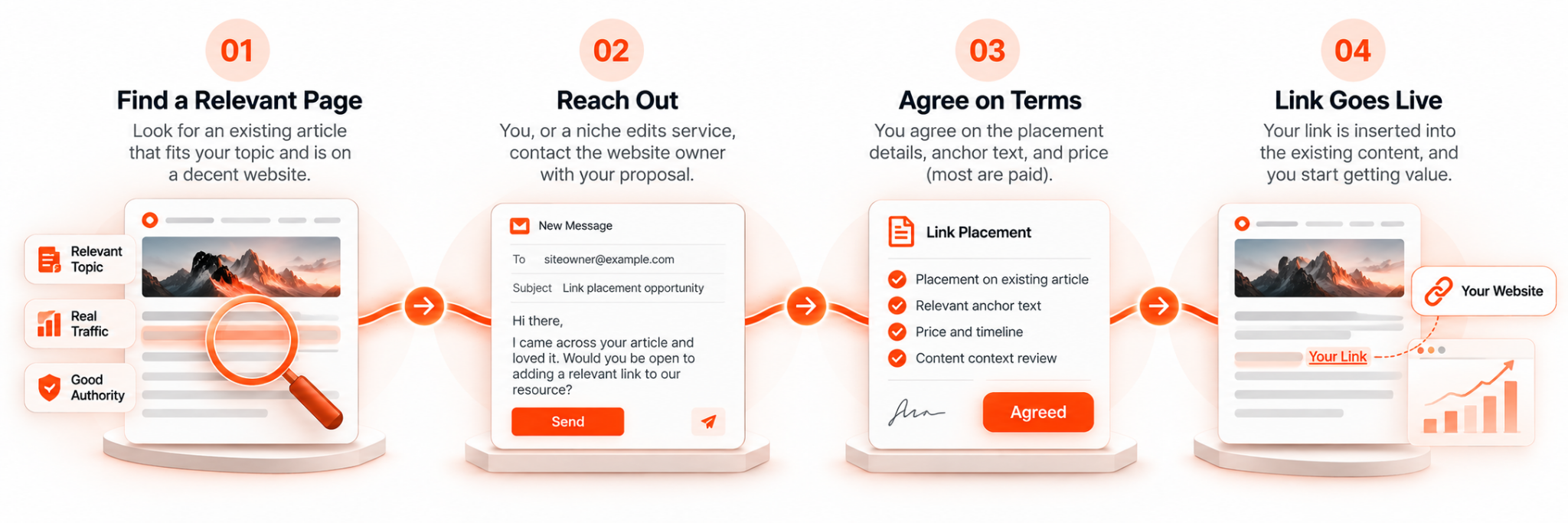
- Find a relevant page. You hunt down an existing article that fits your topic and lives on a decent site.
- Reach out. You, or a niche edits service acting for you, contact whoever runs that site.
- Agree on terms. Most of these placements are paid, so the site owner adds your link for an agreed fee.
- The link goes live. Your link settles into the existing content, usually with the anchor text you asked for.
Picture a project management SaaS for a second. One might drop your link into an existing article called "how remote teams stay organized," right where it talks about scheduling tools. Relevant page, relevant spot, and an audience already reading it.
Get that relevance right, and the link pulls real weight. Get it wrong, and it just sits there, quietly doing nothing for you.
Why Niche Edits Work So Well
Niche edits work because you borrow a page’s existing authority instead of building it from scratch. A brand new guest post starts life at zero. An aged, established page does not.
So what are you actually getting out of it?
- Speed. No new article to write, pitch, or wait around on. The link can go live quickly.
- Existing authority. The page already carries trust, and often backlinks, that your link taps into.
- Faster indexing. Google already crawls the page, so it tends to spot your link sooner.
- Anchor control. Because the surrounding content already fits, you can usually pick a natural anchor.
- Lower cost. You are not paying anyone to write, so niche edit links often cost less than guest posts.
Stack those up and you have a link that can start working in weeks, not months of waiting around.
Niche Edits vs Guest Posts: What Is the Difference?
Both tactics build backlinks. They just take very different routes to get there.
A guest post is a fresh article you write and then place on another site. A niche edit just adds your link to an article already sitting there, published and indexed. So one route has you creating content from scratch, while the other quietly borrows content that already exists.
Neither one really wins outright. They are quicker and lighter on the wallet. Guest posts, though, hand you a whole page to shape and brand however you like. The smartest campaigns tend to just run both at once.
Are Niche Edits Safe? White Hat or Black Hat?
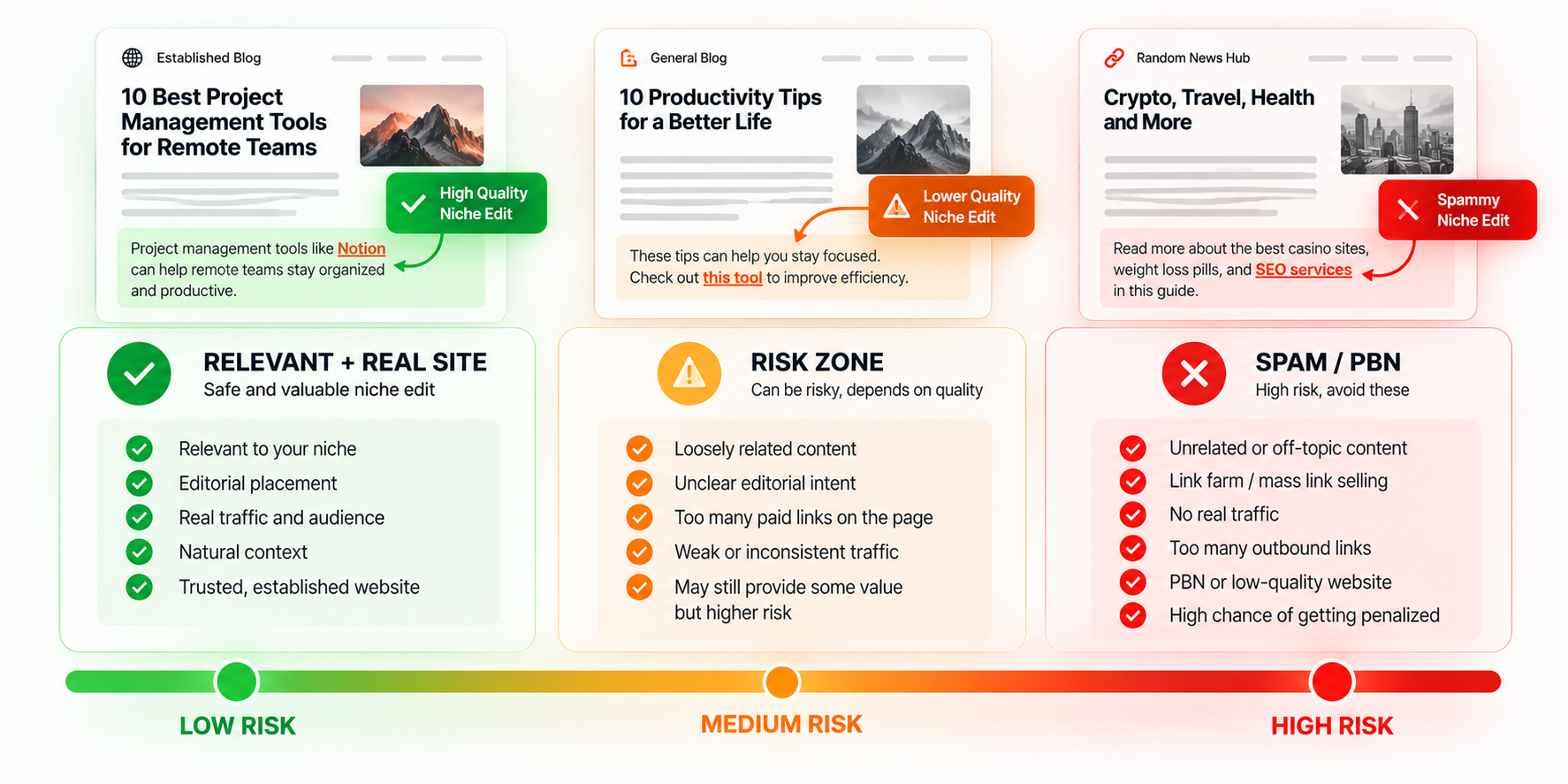
Niche edits are safe when the link is relevant, editorial, and placed on a real site with real traffic. They turn risky the moment they come from spammy pages, PBNs, or mass link-selling operations.
The tactic itself lives in a gray area, and there is no point pretending otherwise. Google does not love paid links. But a contextual link on a genuine, relevant page that adds something for readers looks a lot like a natural editorial link, and it gets treated much the same way.
What actually lands people in trouble is never the link itself. It is the source. Watch for these red flags.
- Links jammed into unrelated content purely because the site sells them.
- Pages that exist for one reason only, to host paid links.
- Sites flashing high DR scores but pulling no real traffic or audience.
Keep your placements relevant and genuinely useful, and you will sit comfortably on the safe side of all this. Start chasing cheap links on junk sites, though, and you are quietly rolling dice with your rankings.
How to Spot a Quality Niche Edit
A quality niche edit sits on a relevant, trafficked page with a clean link profile. The site-wide metrics matter less than most people assume. The individual page matters far more.
Run any placement through these four checks before you commit.
1. Topical relevance
Relevance comes in tiers, and you want to aim as high up them as you can.
- Exact match. The page covers your exact topic. An SEO tool linking from an SEO article. Best case.
- Broad relevance. The page sits in a related field. An SEO tool linking from a general marketing post. Still useful.
- Irrelevant. The page has nothing to do with you. An SEO tool linking from a gardening blog. Skip it.
2. Real traffic, not just DR
This is the check most people fumble. A high domain rating means very little if the page itself pulls no visitors. A mid-DR page with a real, steady audience will out-earn a high-DR page nobody actually reads. Look at the traffic, not just the badge on the homepage.
3. A clean outbound link profile
Take a good look at what else the page links out to. If it is stuffed with unrelated paid links to casinos and crypto, turn around and leave. What you want to see is a handful of relevant, natural outbound links and nothing that reeks of a link farm.
4. Indexed and ideally ranking
The page should be indexed by Google at a bare minimum, and it is better still if it ranks for real keywords. A page that ranks is a page carrying weight, and that weight is exactly what you are paying to borrow.
How Much Do Niche Edits Cost in 2026?
Niche edits typically cost between $150 and $600 per placement in 2026, depending on the page’s authority and traffic. Premium and news sites climb well past that.
Roughly, this is how the market breaks down.
A quick word on the cheap end. If someone offers to sell you niche edit links for $20 a pop, take that as your signal to leave. Real placements on real sites cost real money, because an actual site owner is editing their own live page to fit your link in.
How to Buy Niche Edits Safely
Buying them really comes down to one thing: trusting the right provider. A good niche edits service will be upfront about exactly where your links are going. The shady ones stay vague, and usually that is because the actual sites would send you running.
Before you pay for any niche edit services, get straight answers on these.
- Which sites? You should get to approve every target site before a single link goes live.
- Real traffic? Ask for actual traffic data, not just a DR screenshot with a big number on it.
- Relevant placements? Confirm the pages genuinely fit your niche before agreeing to anything.
- What anchor text? You should have a say, and the anchor should read naturally, not stuffed.
- What if it drops? A solid provider replaces any link that gets removed later on.
One simple question sorts the good providers from the rest. Ask them to name the exact page your link will land on, before any money changes hands. A transparent provider just tells you. The moment one gets cagey, keep looking.
Niche Edits and AI Search Visibility
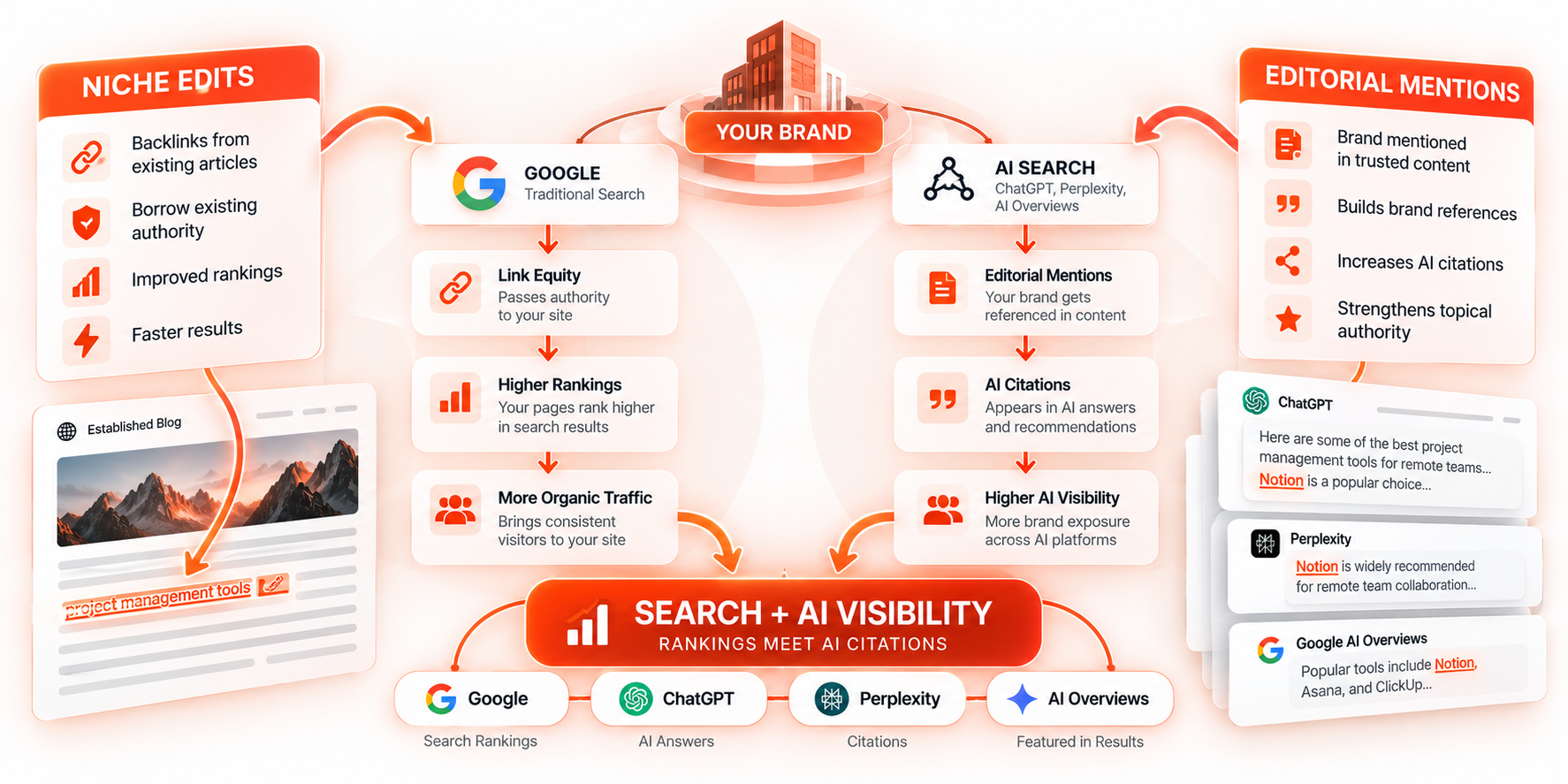
This is the part almost every other guide skips right over. Niche edits are excellent for rankings, but in the age of AI search, they only tell half the story.
Niche edit links build link equity, and link equity helps you climb Google. Yet when ChatGPT, Perplexity, and Google AI Overviews stitch together an answer, they lean heavily on editorial mentions, the moments your brand gets named and cited on pages those engines already trust. A link tucked into an old post does far less of that particular job.
So the strongest play runs both at once. One side does the heavy lifting on authority and rankings. Editorial placements and real brand mentions are what earn you a spot inside the AI answer itself.
That combination is exactly what Anchorial is built around. Anchorial places niche edit links for ranking power, and it gets your brand added to the very pages ChatGPT, Perplexity, and Google AI Overviews already cite. One side builds your authority. The other gets you named in the answer itself.
The Bottom Line
Niche edits are one of the fastest, most cost-effective ways to build links, provided you respect the single rule that actually matters. Quality over absolutely everything else.
Skip the cheap junk. Chase relevance, real traffic, and clean pages instead. Vet any provider hard, approve every placement yourself, and keep your anchor text natural.
Do that, and they turn into a dependable engine for authority and rankings. Pair them with real editorial mentions, and you show up both on Google and inside the AI answers your buyers increasingly trust.
Frequently Asked Questions
Are niche edits safe?
Yes, niche edits are safe when the link is relevant and placed on a real site with genuine traffic. They become risky when they come from PBNs, spammy pages, or sites that exist only to sell links. Quality and relevance decide it.
Are niche edits white hat or black hat?
They sit in a gray area. A relevant, editorial link that helps readers gets treated much like a natural link. A paid link forced onto an unrelated or spammy page leans black hat. The placement decides which side you land on.
How much do niche edits cost?
They usually cost $150 to $600 per placement in 2026, based on the page’s authority and traffic. Premium and news sites cost more. Anything priced at a few dollars is almost always low quality and best avoided.
What is the difference between niche edits and guest posts?
A niche edit adds your link to an article that already exists. A guest post is a new article you write and place. Niche edits are faster and cheaper, while guest posts give you a full page to control. Many campaigns use both.
Do niche edits still work in 2026?
Yes, they still work in 2026 when they are relevant and high quality. They build link equity and can move rankings quickly because the host page already has authority. Low-quality niche edits do not work and can hurt you.
What is a niche edit link?
A niche edit link is a backlink inserted into existing content on another website. It is also known as a link insertion or a curated link. The link sits inside a published article rather than in a new one written just for it.
Are niche edits worth it?
They are worth it when you buy quality placements on relevant, trafficked pages. They are faster and often cheaper than guest posts. They are not worth it if you chase cheap links on low-quality sites, which can trigger penalties.
How fast do niche edits work?
They often work faster than other links because the host page is already indexed. Google tends to notice the new link within days to weeks. Ranking movement usually follows over the next one to three months.